
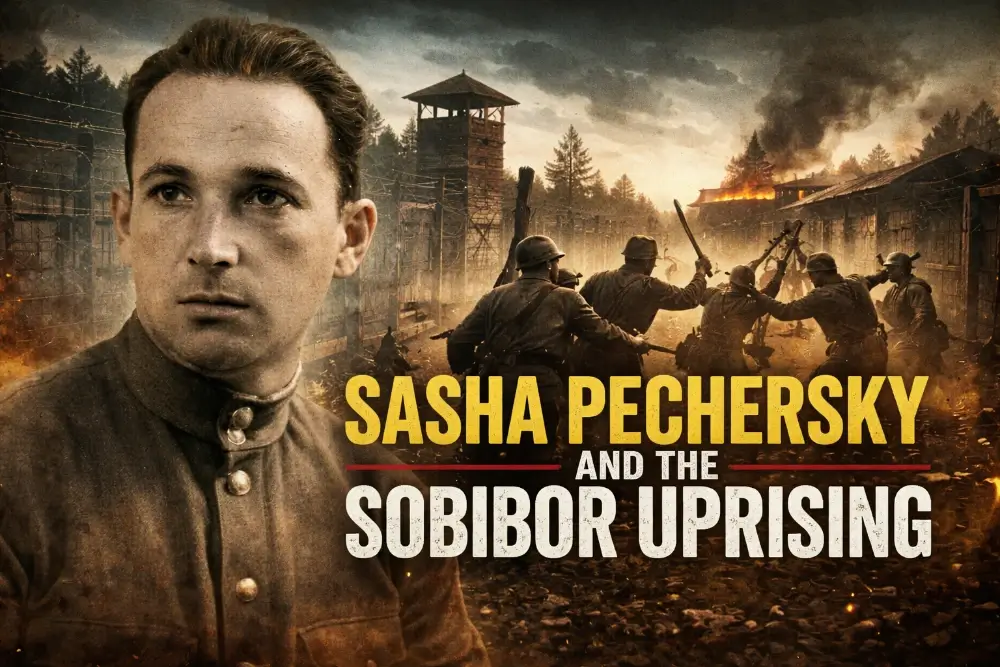

The afternoon looked ordinary from a distance. That was part of the danger. In Sobibor, routine was camouflage: a tailor’s bench, a workshop order, a guard passing by, a prisoner carrying cloth or boots. On October 14, 1943, that routine became a weapon. SS men were lured into isolated spaces and killed one by one. Then the quiet cracked open. Prisoners ran for the fence. Mines waited beyond it. Pechersky had spent only weeks in the camp, but by then he had already helped turn survival into strategy.
Sobibor was not a prison in the ordinary sense. It was a killing center created by Nazi Germany for the sole purpose of murdering Jews, and it was built in the spring of 1942 as part of Operation Reinhard. The camp belonged to a broader system of industrial murder in occupied Poland. At least 167,000 people were murdered there, and the camp’s design made speed, secrecy, and disappearance part of the machinery itself.
Key Facts
- Primary figure: Alexander “Sasha” Pechersky.
- Role: Soviet Jewish officer and commander of the Sobibor revolt.
- Event: The Sobibor uprising.
- Date: October 14, 1943.
- Location: Sobibor extermination camp, German-occupied Poland.
- Main tactic: Luring SS men into workshops and killing them quietly before escape.
- Estimated escaped prisoners: About 300.
- Estimated survivors of the war: About 50.
- Camp fate after the revolt: Demolished and concealed.
- Historical significance: One of the most important acts of Jewish resistance in a Nazi killing center.
The reason the Sobibor uprising still matters is simple: it happened inside a place designed to make resistance seem impossible. That is what gives the story its tension. It is not just the story of a brave man. It is the story of a system, a deadline, and a choice made under lethal pressure.
Table of Contents
Historical Background: The World That Created Sobibor
Operation Reinhard was the Nazi plan to murder the Jews of the General Government in occupied Poland, and Sobibor was one of the central killing centers built for that task. These camps used assembly-line methods of murder. At Sobibor and the other Reinhard camps, victims were generally killed with carbon monoxide gas produced by engine systems. The design of the camp was therefore not accidental architecture; it was murder organized as infrastructure.
Sobibor was also hidden. It sat in a forested region, away from major scrutiny, and the site was divided into functional zones that supported deportation, processing, and killing. That isolation mattered. It gave the SS time. It gave them secrecy. And it forced prisoners to understand that any escape plan would have to break through not only fences, but a whole landscape built to keep the world from seeing what was happening inside.
Key Takeaways
- Sobibor was an extermination camp, not a labor camp.
- It existed within Operation Reinhard.
- Its killing system depended on speed, isolation, and concealment.
Who Was Sasha Pechersky?
Alexander Pechersky was born in 1909 in the Russian Empire region that is now Ukraine. He became a Soviet officer, and when Germany invaded the Soviet Union in June 1941, he was called into military service. He was captured in October 1941. Later, after a medical examination revealed that he was Jewish, he was deported to Sobibor on September 22, 1943, after time in captivity elsewhere, including Minsk.
That background matters because Pechersky was not simply another exhausted prisoner. He arrived with military habits already formed: command discipline, tactical thinking, and an instinct for coordination under pressure. Those qualities became decisive once he was forced into the camp’s labor structure.
His arrival changed the emotional temperature inside Sobibor. The prisoners already knew that the camp was devouring people. What they did not yet have was the sort of leader who could convert fear into a plan that others could trust. Pechersky became that figure.
How Sobibor Worked
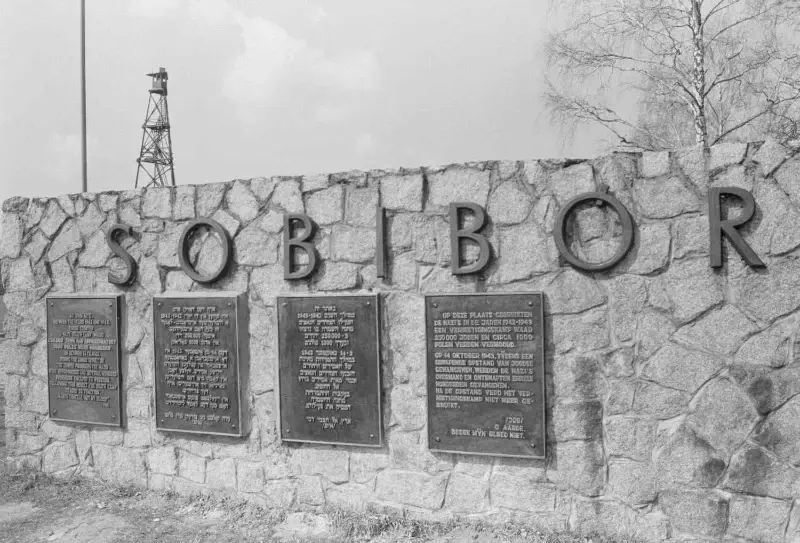
Sobibor’s function was brutally simple: deport, sort, murder. The camp included zones for administration, prisoner labor, storage, and killing. The majority of arrivals were not meant to live long enough to learn the layout. Those selected for labor survived only temporarily, maintained only because the camp needed hands to keep itself running.
That labor system created one opening. Prisoners who repaired clothing, handled tools, or moved through workshops could exchange information. They could watch patterns. They could identify weaknesses. The same system meant to sustain the camp also gave prisoners a narrow corridor for resistance.
In the summer of 1943, prisoners began to fear that the camp might soon be dismantled after a decline in transports. That fear sharpened into urgency. Leon Feldhendler, who led an underground group of Polish Jewish prisoners, formed a secret committee to plan escape. But the group lacked military experience, and progress was slow until Pechersky arrived.
Key Takeaways
- Sobibor survived by forcing prisoners to sustain the camp itself.
- Labor created the only meaningful opening for conspiracy.
- The revolt emerged from fear that the camp would be liquidated and the prisoners murdered anyway.
Planning the Sobibor Uprising
The revolt was not spontaneous. It was engineered. According to the EHRI archival record, Pechersky drew up a detailed escape plan over about three weeks after his arrival. The plan had to answer three problems at once: how to kill guards quietly, how to avoid raising an alarm too early, and how to get hundreds of prisoners moving before the camp could seal itself.
The prisoners had almost no conventional weapons. They relied mainly on axes and knives, along with a few stolen firearms. That shortage forced the plan to depend on timing and deception rather than force-on-force combat. The tactic was to summon SS men to workshops on the pretext of fittings or labor tasks, then kill them silently in isolated spaces before the camp understood what was happening.
Cause – Action – Result
- Cause: The camp system was vulnerable to routine and vanity.
- Action: Prisoners used tailoring workshops as traps.
- Result: SS men were killed before the alarm system could fully react.
This is the point where the story tightens. The plan worked only if every step stayed hidden long enough. One loud mistake could end everything. The prisoners knew it. The SS did not. Not yet.
The Day the Camp Broke Open
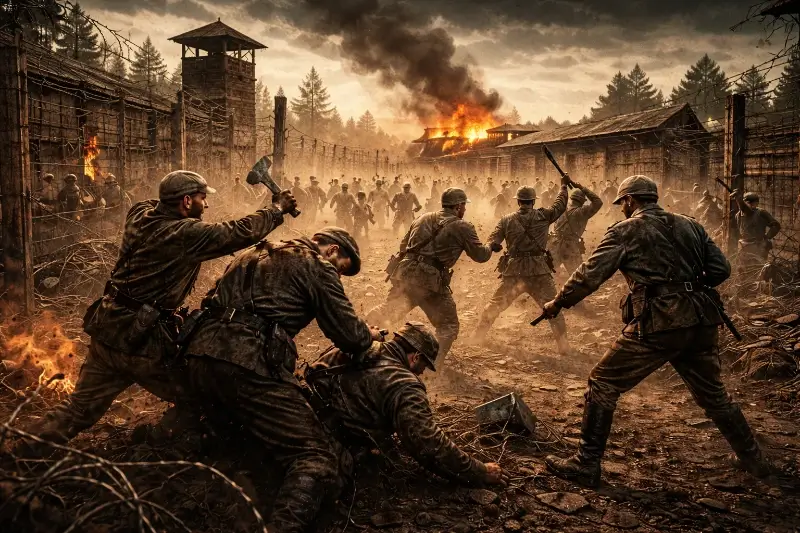
On October 14, 1943, prisoners led by newly arrived, battle-tested Soviet Jewish POWs revolted. They exploited the vanity and greed of the SS men, drawing them into different tailor workshops under the pretense of fittings. The first phase was silent killing. The second was panic. The third was escape.
The revolt killed 11 SS staff members, including deputy commandant Johann Niemann. Other accounts describe 12 SS officers and guards being killed in the overall action, while the museum and encyclopedia record 11 SS staff killed that day. The central historical point is not the exact rhetorical count used in later retellings, but the fact that the camp’s command structure was shattered from within.
Once the alarm spread, approximately 300 prisoners escaped through barbed wire and minefields. Only about 50 survived the war. The rest were hunted down, killed during the escape, or murdered afterward. Sobibor did not become free. It became briefly ungovernable, which was enough to make history.
Key Takeaways
- The uprising depended on deception, not firepower.
- The SS command chain was disrupted inside the camp.
- Hundreds escaped, but only a small fraction survived the war.
Why the Revolt Mattered Militarily
Sobibor was designed as a closed system. Its purpose was to process human beings into death with minimal visibility and minimal delay. The revolt forced the opposite: noise, disorder, pursuit, and exposure. The Germans responded by murdering any prisoners left behind and then dismantling the site. Camps I and II and the German living quarters were demolished, and Camp III was plowed over and planted with pine trees to conceal the crime.
That response tells the real military story. The revolt did not simply save lives. It exposed the camp’s dependence on obedience and secrecy. Once those conditions were broken, the system could not be safely restored. Sobibor was closed because its function had become too dangerous to maintain.
After the Escape: Survival Was Not the End
Pechersky survived the uprising and later joined Soviet partisan forces. He kept fighting after Sobibor, then returned to the Soviet military structure as the war continued. His survival was real, but it was never clean. It came with memory, loss, and the burden of having seen what had happened inside the camp.
After the war, he devoted himself to telling the world about Sobibor. That effort lasted until his death in 1990. The problem was not only personal silence. It was political silence. David Bezmozgis’s Tablet essay explains that Soviet public memory often avoided acknowledging the specifically Jewish nature of Holocaust suffering, preferring language about generic Soviet victims instead. For much of the Soviet period, that meant the tragedy at Sobibor remained underrecognized and its Jewish meaning muted.
That is the second battle in Pechersky’s life. The first was to escape the camp. The second was to force the world to remember it accurately.
Legacy: Why the Sasha Pechersky Sobibor Uprising Still Matters
The Sobibor revolt remains powerful because it is not a fantasy of easy victory. It is a record of constrained choice. Prisoners inside a death camp studied routines, exploited weaknesses, and risked everything to create a window for escape. They did so in a place built to erase evidence, language, and identity.
Today, Sobibor stands as a warning and a correction. It warns what bureaucratic murder looks like when a state organizes it with precision. It also corrects a common misconception: Jewish victims did not only die. They resisted, organized, and fought back under conditions designed to make resistance seem impossible. The Sobibor uprising is one of the clearest examples of that fact.
The emotional force of Pechersky’s story comes from its unfinished quality. He did not live to see the full restoration of his reputation. He did not get the easy ending that public memory often prefers. But history has a longer patience than propaganda. In the end, the camp was remembered, the revolt was recovered, and Pechersky’s name returned to the story where it belonged.
If Sobibor was designed to make people vanish, the uprising made one truth impossible to erase: even in the machinery of extermination, resistance could still interrupt the system. That interruption is the legacy of Sasha Pechersky.
Timeline
- 1909: Alexander Pechersky is born in Kremenchug, in what is now Ukraine.
- June 1941: Germany invades the Soviet Union; Pechersky is called into military service.
- October 1941: Pechersky is captured by German forces.
- Spring 1942: Sobibor is constructed as a killing center under Operation Reinhard.
- September 22, 1943: Pechersky is transported to Sobibor from Minsk after his Jewish identity is revealed.
- Three weeks before the revolt: Pechersky helps draw up a detailed escape plan.
- October 14, 1943: The Sobibor uprising begins; 11 SS staff are killed and about 300 prisoners escape.
- After October 1943: Sobibor is dismantled and concealed with pine trees.
- Postwar decades: Pechersky continues speaking about Sobibor until his death in 1990.

Add your first comment to this post