
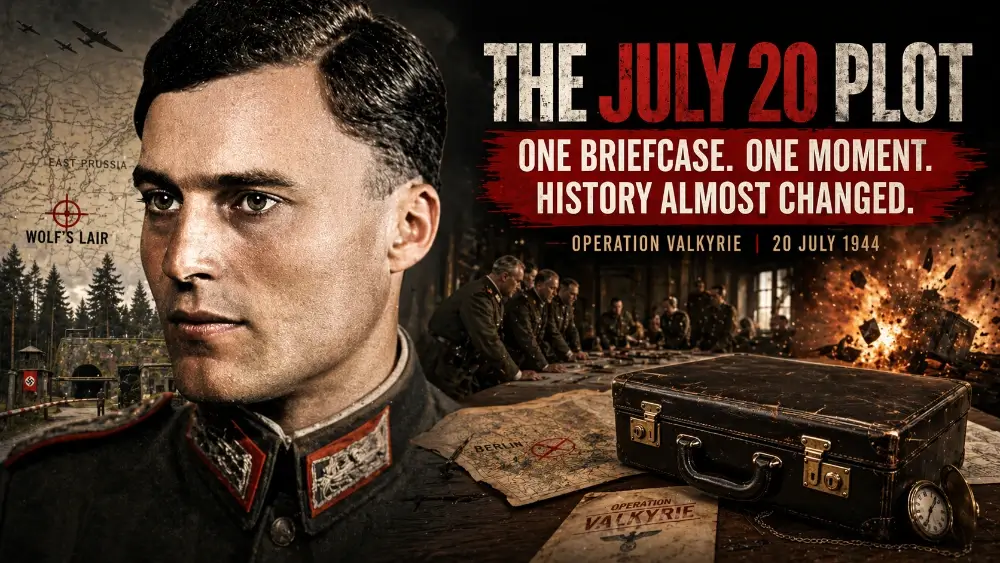

The room at the Wolf’s Lair was built for command, not mercy. Maps lay open. Officers waited. Heat pressed against the walls. Then Claus von Stauffenberg stepped forward with a briefcase that held a bomb, and the July 20 Plot moved from conspiracy into action. For a few seconds, the fate of Nazi Germany depended on a meeting table, a briefcase, and whether Hitler remained in the blast’s path.
That is what makes the story endure. It was not only an assassination attempt. It was a coup plan built around timing, confusion, and the belief that if Hitler died, the regime might crack before it could recover. The conspirators were trying to turn one explosion into a transfer of power.
Table of Contents
Key Takeaways
- The July 20 Plot was the most serious internal German attempt to kill Hitler and overthrow the Nazi regime.
- Operation Valkyrie was transformed from an emergency plan into a coup blueprint.
- Stauffenberg’s access to Hitler made the attempt possible, but only one bomb was primed and the blast was weakened by the room’s physical layout.
- Hitler survived, and that survival caused the Berlin coup effort to collapse.
- The aftermath included executions, arrests, family punishment, and decades of historical debate over the conspirators’ motives.
Historical Background
The July 20 Plot emerged from a Germany that was already beginning to collapse under the weight of its own war. By late 1943 and early 1944, opposition to Hitler in high army circles had grown as Germany’s military situation deteriorated. The coup plan, code-named Walküre or Valkyrie, took shape in that atmosphere of defeat, suspicion, and fear.
In 1944, the strategic picture worsened quickly. The Allied landings in Normandy opened the Western Front on 6 June, while the Soviet summer offensive devastated German positions in the east. Germany was now fighting a multi-front war it could no longer dominate. That collapse mattered because the plotters did not act in a vacuum; they acted when defeat had become impossible to ignore.
The resistance against Hitler was real, but it was not simple. The US Holocaust Memorial Museum notes that the July 20 plot involved both civilian and military officials, and that the conspirators’ motivations and place in Third Reich history remain an area of intense debate. Some wanted to save Germany from destruction. Some wanted to preserve the army’s honor. Some hoped a post-Hitler government could negotiate better peace terms with the Allies.
Germany in crisis
Hitler’s own behavior made the regime harder to oppose. As the war turned against Germany, he became more suspicious and harder to reach, often changing his schedule abruptly. That made earlier assassination attempts fail and forced the conspirators to keep waiting for another opening. By July 1944, they believed they might not get one.
That sense of closing time is central to the story. The July 20 Plot was a late act of resistance, carried out by men who understood that the regime was brutal, the war was lost, and hesitation could make them accomplices in everything that followed.
Operational Role and Resistance Network
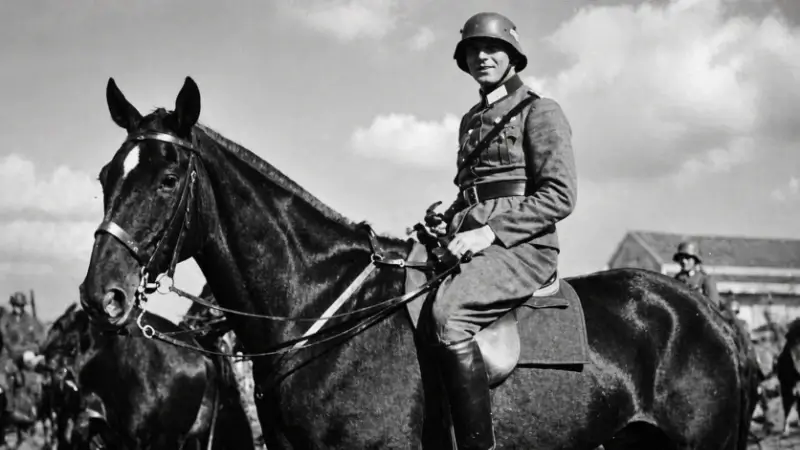
Claus von Stauffenberg was not an obvious revolutionary. He was an aristocratic, Catholic career officer whose injuries in Tunisia had left him with one eye, one hand, and two fingers missing from the other hand. By 1944, he had become one of the few men inside the system who could get close enough to Hitler to act directly.
His access was crucial. As chief of staff for the commander of the German Replacement Army, he could attend military briefings where Hitler was present. That position turned him into the plot’s execution point, the man whose briefcase would carry the bomb into the room.
The conspiracy behind Stauffenberg
The plot was not a one-man undertaking. It brought together military officers, conservative elites, and civilian collaborators. That broad coalition matters because it shows the July 20 Plot as a networked resistance effort rather than a sudden personal act. The Bendlerblock in Berlin became the command center of that conspiracy and later the place where the main plotters were executed.
The German Resistance Memorial Center describes the Bendler Block as the site best remembered for the attempt to overthrow the National Socialist regime on 20 July 1944. In other words, the conspiracy lived in two places at once: the Wolf’s Lair where Hitler was targeted, and Berlin where the coup machinery was supposed to take over.
Operation Valkyrie and the Coup Plan
Operation Valkyrie was originally an emergency plan, not a rebellion. The conspirators adapted it into a coup mechanism. Once Hitler was dead, they intended to use the Replacement Army to take control of Berlin, neutralize the SS, and convince officials that the regime had already been seized from within.
This was a plan built on speed. The assassination was only the first step. The real challenge was what happened in the next minutes and hours: who believed the reports, who transmitted the orders, and who moved first. If Hitler survived, the psychological foundation of the coup would disappear. That is exactly what happened.
Why the plan depended on confusion
The logic was brutally simple. Cause: Hitler dies. Action: Berlin receives emergency orders under Valkyrie. Result: the conspirators seize control before the Nazi leadership can respond. But if the cause failed, the entire chain broke. Once Hitler’s survival became known, confusion turned against the plotters instead of for them.
That is why the July 20 Plot is studied not just as history, but as an operation. It shows how coup planning depends on command clarity, communications discipline, and speed under pressure. When those elements fail, even a near-perfect opening can collapse in minutes.
Technology and Equipment
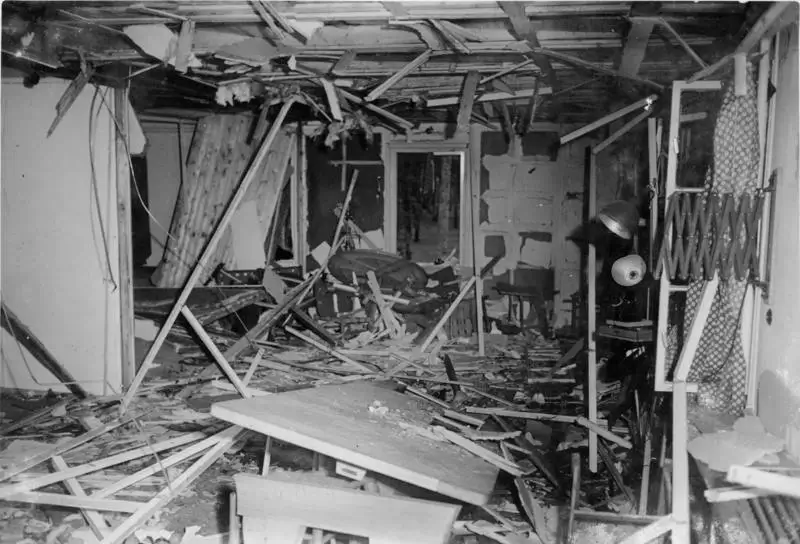
The weapon Stauffenberg carried was simple and deadly: a briefcase bomb with a timed detonator. Time’s account of the plot notes that only one bomb was primed because of time pressure, even though two were intended. That reduced the blast’s destructive margin and made every physical detail in the room more important.
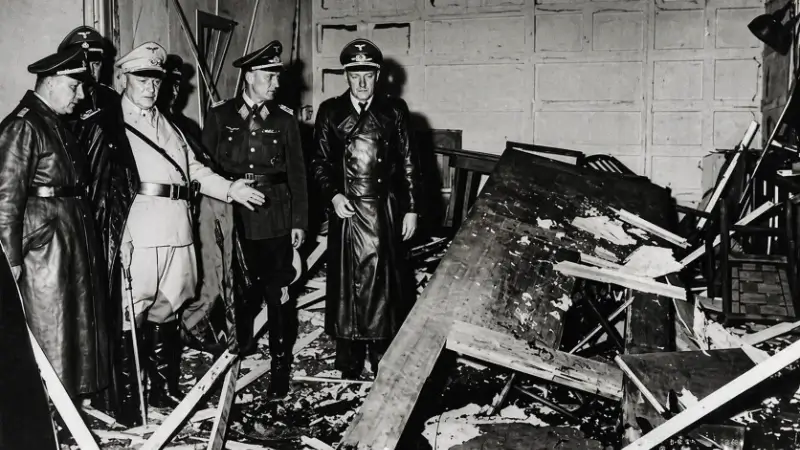
The environment mattered too. Time reports that the meeting had been moved to a wooden bunker, which weakened the blast’s effect. The briefcase was also moved, and a table leg helped shield Hitler from the explosion. The bomb still killed four people and injured others, but the physical layout kept Hitler alive.
The briefcase and the table
This is one of the most famous details in modern war history because it shows how a political catastrophe can hinge on material accident. The briefcase was meant to be close enough to kill Hitler. It was not. The table leg did not defeat the plot by design; it did so by coincidence. Yet that coincidence changed the outcome of the war within the room.
The Wolf’s Lair as a target
The Wolf’s Lair (Wolfsschanze) was not a soft target. It was Hitler’s hardened field headquarters in East Prussia, a place chosen for security and control. That made the operation harder and increased the importance of timing, access, and concealment. The plotters had one chance inside one controlled space, and they lost it by inches.
July 20 Plot: Timeline and Key Facts at a Glance
The clearest way to understand the July 20 Plot is to follow the sequence.
Key facts
- Event: Failed assassination attempt on Adolf Hitler and coup effort.
- Date: 20 July 1944.
- Main figure: Claus von Stauffenberg.
- Primary location: Wolf’s Lair, East Prussia.
- Berlin command site: Bendlerblock.
- Operation name: Valkyrie.
- Immediate result: Hitler survived; the coup failed.
Timeline
- Late 1943 to early 1944: Opposition to Hitler grows in high army circles as Germany’s military position worsens, and the Valkyrie plan is set in motion.
- 6 June 1944: Allied forces land in Normandy, opening the Western Front.
- June 1944: The Soviet summer offensive devastates German forces in the east, deepening the sense that the war is being lost.
- 20 July 1944, morning: Stauffenberg arrives at Hitler’s briefing with a bomb in his briefcase.
- 20 July 1944, during the briefing: Only one bomb is primed, the briefcase is moved, and the explosion fails to kill Hitler.
- 20 July 1944, later that day: The Berlin coup effort begins to unravel as confirmation of Hitler’s survival spreads.
- Night of 20 July 1944: Stauffenberg and other leaders are arrested and executed at the Bendlerblock.
- Aftermath: The Nazi regime launches arrests and reprisals against plotters and their families.
Human Experience and Repression
The failure of the plot did not end in the conference room. It spread into homes, offices, and prison cells. The BBC account of the story notes that Stauffenberg’s family was arrested in the aftermath, and that his children were sent away under different names. The plot was not only a military act. It became a family tragedy.
The Nazi response was designed to terrify anyone else who might consider resistance. The goal was not simply punishment. It was deterrence through collective suffering. The plotters were executed, relatives were detained, and the regime used the failure to prove that betrayal would destroy not just the individual but everyone connected to him.
Stauffenberg’s family
BBC’s reporting on the plot describes the shock of the family more than the mechanics of the bomb. That detail matters because it shows what authoritarian punishment does best: it reaches beyond the political center and into private life. The cost of failure was carried by wives, children, parents, and siblings who had not stood in the room at the Wolf’s Lair but still paid for what happened there.
Legacy and Recognition
The July 20 Plot remains controversial because its conspirators were not uncomplicated heroes. The USHMM emphasizes that their motives and historical role remain debated. Some wanted to save Germany; some wanted to preserve the army’s honor; some were deeply compromised by earlier loyalty to the regime. The historical record does not flatten that ambiguity, and it should not.
And yet the legacy is still clear. The Bendlerblock is now a memorial site, and the German Resistance Memorial Center preserves the place where the plotters were executed. What was once denounced as treason is now remembered as resistance against Nazi rule. That shift in memory says as much about postwar Germany as it does about 1944.
The story also endures because it explains how dictatorships can appear invincible while remaining structurally fragile. Hitler survived the blast, but the regime had already been weakened by military disaster, paranoia, and internal fracture. The July 20 Plot did not end the war, but it exposed the fault lines inside the Nazi state.

Add your first comment to this post