
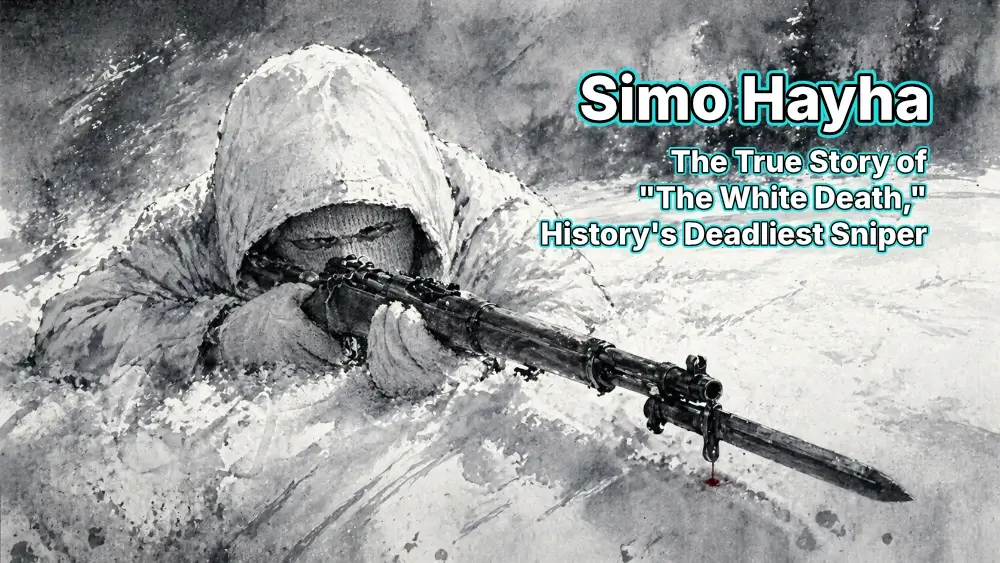

Simo Hayha is one of the most remarkable figures in modern military history. Known to Soviet soldiers as “The White Death,” he became a symbol of discipline, patience, and battlefield precision during the Winter War between Finland and the Soviet Union. His story is not only about extraordinary marksmanship. It is also about preparation, survival, and the harsh reality of war in the frozen forests of Karelia.
What makes Simo Hayha so compelling is that he was not a career soldier built by a military academy. He was a Finnish farmer, hunter, and Civil Guard marksman who learned his craft long before the war began. When conflict arrived, he used the skills shaped by the forest, the snow, and the severe Finnish winter to devastating effect.
Table of Contents
Who Was Simo Hayha?
Simo Hayha was born on 17 December 1905 in Rautjärvi, in the Karelian region of southeastern Finland. He grew up in a rural farming family and spent much of his early life outdoors. The landscape around him was cold, quiet, and demanding. Those conditions shaped his character and later defined his military effectiveness.
From a young age, Hayha learned to ski, hunt, estimate distance, and remain still for long periods of time. These were not abstract lessons. They were survival skills. In Karelia, the forest rewarded patience and punished noise. That environment trained him in ways that would later prove invaluable during combat.
Hayha joined the Finnish Civil Guard at 17 and developed his shooting ability through competition and practice. He later completed military service, but his real foundation came from years of hunting and disciplined field experience. By the time the Winter War began, he already possessed the instincts of a highly capable marksman.
The Winter War and the Soviet Invasion of Finland
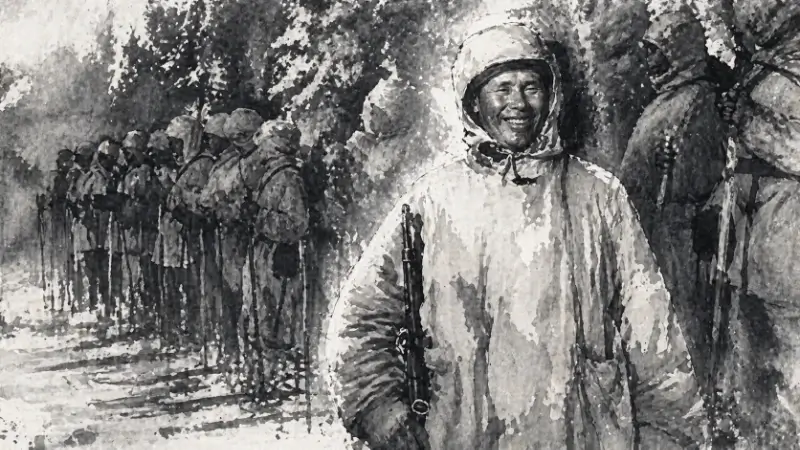
The Winter War began on 30 November 1939, when the Soviet Union invaded Finland. The conflict lasted 105 days and became one of the most dramatic examples of a small nation resisting a far larger power.
The Soviet leadership expected a rapid victory. Stalin’s government believed that Finland could be overrun quickly. That assumption proved disastrous. Finnish geography, severe winter conditions, and determined resistance turned the campaign into a brutal struggle.
The terrain itself favored the defenders. Finland’s forests, frozen lakes, and limited road networks made large-scale Soviet maneuvering difficult. Armored vehicles and mass infantry formations struggled in the deep snow and dense woodland. Finnish troops, by contrast, knew the land intimately. They used skis, white camouflage, and mobile tactics to their advantage.
This was the world in which Simo Hayha became a legend.
The Battle of Kollaa
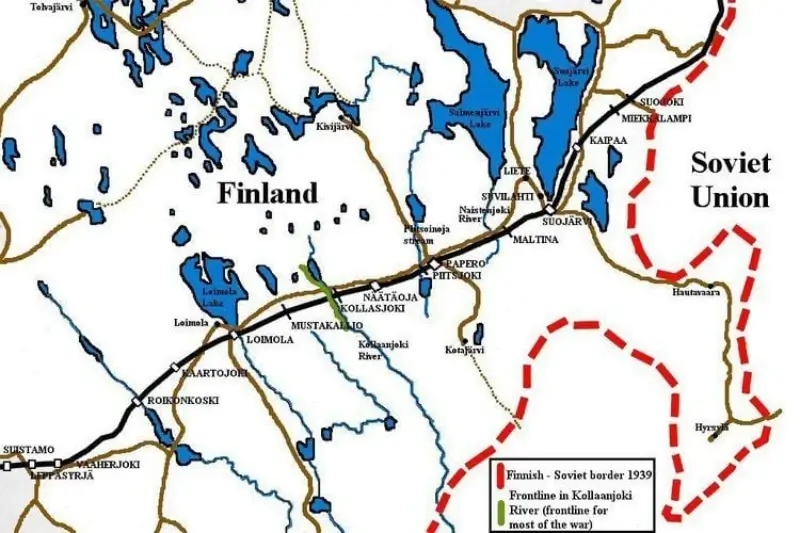
Hayha served in the Kollaa sector, one of the most important and fiercely contested fronts of the Winter War. The Battle of Kollaa lasted from 7 December 1939 to 13 March 1940 and became a symbol of Finnish resilience.
At Kollaa, a small number of Finnish troops defended against much larger Soviet forces. The fighting was intense, continuous, and unforgiving. The ground was frozen hard, fortifications were difficult to build, and visibility was often poor. Every shot mattered.
It was here that Hayha earned his nickname. Soviet soldiers, unable to locate him and unable to return effective fire, began referring to him as Belaya Smert, or The White Death. The name captured both his camouflage and the fear he inspired.
Why Simo Hayha Used Iron Sights Instead of a Scope
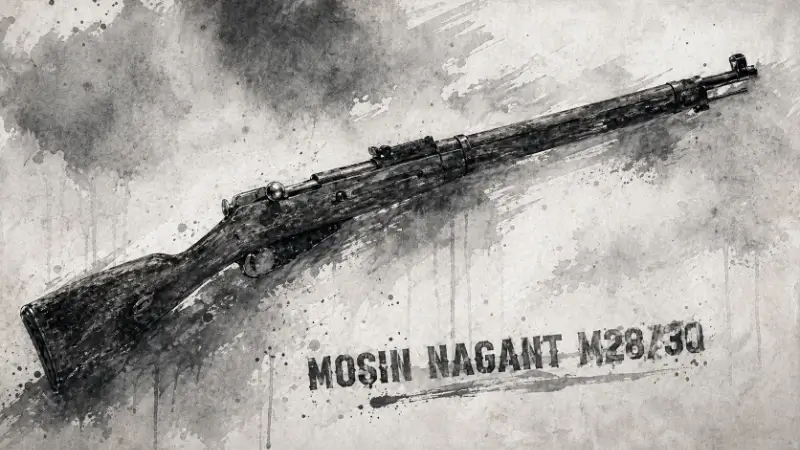
One of the most famous details about Simo Hayha is that he did not use a telescopic sight. He preferred iron sights on his rifle, and that choice was based on practical battlefield logic.
First, a scoped rifle requires the shooter to raise the head slightly higher. In snow-covered terrain, even a small movement can expose a sniper’s position. Second, extreme cold can fog, freeze, or otherwise impair optical equipment. Third, iron sights were faster and more reliable at the distances Hayha expected to engage targets.
His preferred rifle was the Finnish Civil Guard M/28-30, a refined Mosin-Nagant variant chambered in 7.62x53R. It was accurate, durable, and familiar to him. Because he had trained extensively with that weapon before the war, he knew exactly how it performed.
This was not luck. It was the result of experience, repetition, and discipline.
The Methods That Made Him So Effective
Simo Hayha was more than a skilled shooter. He was a master of concealment and fieldcraft.
He prepared his positions in advance, often visiting the site the night before combat. He studied the angle of light, the shape of the terrain, and the likely paths of movement. He packed snow around his rifle muzzle to reduce the visible disturbance from firing. He even placed snow in his mouth so that his breath would not reveal his position in the cold air.
He wore white camouflage from head to toe and stayed low to the ground. He understood that survival depended on invisibility. In many ways, his greatest weapon was not the rifle itself but his ability to disappear into the landscape.
Hayha also avoided predictable behavior. He did not remain in one place for long. He changed positions and varied his routine to reduce the chance of counter-sniper action. His method was simple, disciplined, and brutally effective.
The Numbers Behind the Legend
The exact number of Simo Hayha’s kills has been recorded in several ways, depending on the source and the accounting method used. The most widely cited confirmed number is 259 rifle kills, documented in the diary of military chaplain Antti Rantamaa. Other Finnish records and later estimates place his total number of kills at more than 500 when submachine gun kills are included.
Even the most conservative figure places him among the deadliest snipers in documented military history.
What is especially striking is the time frame. Hayha achieved these results in fewer than 100 days of active combat, in temperatures that often fell far below freezing. On one day, 21 December 1939, he is credited with 25 kills. That single day became one of the most extraordinary individual combat performances ever recorded.
The Day Simo Hayha Was Wounded
On 6 March 1940, near the end of the Winter War, Simo Hayha was shot in the face by a Soviet explosive bullet. The round shattered the left side of his jaw and nearly killed him.
He was found unconscious after the engagement and initially believed to be dead. A Finnish soldier later noticed movement and confirmed that he was still alive. He was evacuated for emergency treatment and remained unconscious for several days.
Hayha eventually survived, but the injury had lifelong consequences. He underwent many surgeries and was permanently disfigured. His recovery was long and difficult, and his speech was affected for the rest of his life.
Life After the War
The Winter War ended on 13 March 1940, but Finland was forced to cede territory to the Soviet Union. This included Karelia, the region where Hayha had been born and raised. Like many Karelians, he lost his home and had to rebuild his life elsewhere.
After the war, Hayha returned to a quiet civilian existence. He farmed, hunted, and lived away from public attention. In 1940, he was promoted directly from corporal to second lieutenant by Field Marshal Carl Gustaf Emil Mannerheim, a rare honor that reflected his extraordinary wartime service.
Despite his fame, Hayha remained private and modest. He did not seek attention. He preferred the outdoors, the company of hunting dogs, and the routines of rural life. For him, survival and duty mattered more than recognition.
He died on 1 April 2002 at the age of 96.
Why Simo Hayha Still Matters Today
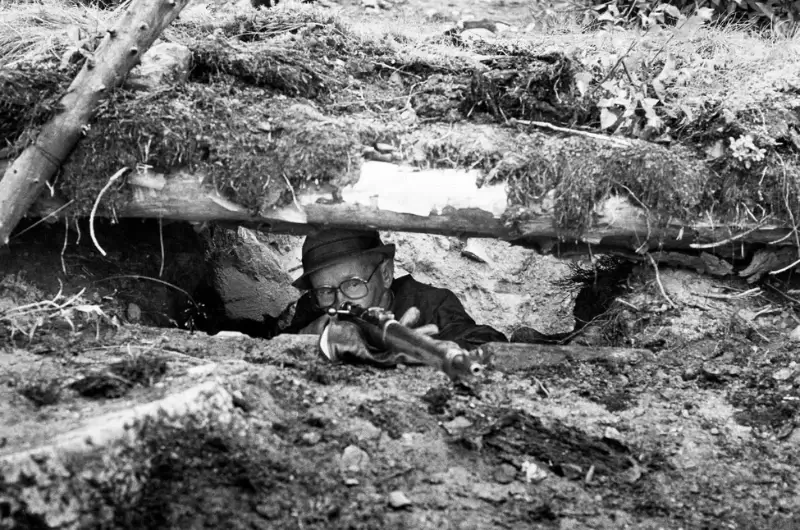
The story of Simo Hayha continues to attract attention because it represents more than battlefield statistics. It reflects a broader historical truth: preparation, terrain knowledge, and discipline can outweigh raw numerical superiority.
His legacy also resonates because it is deeply tied to Finnish national identity. The Winter War remains a defining chapter in Finland’s history, and Hayha stands as one of its most iconic figures. He represents resilience under extreme pressure and the ability of a small nation to resist overwhelming force.
For modern audiences, Hayha’s story is memorable because it combines history, strategy, and human endurance. He was not built for legend. He became one because of the conditions he mastered and the war that found him.
Conclusion
Simo Hayha remains one of the most extraordinary marksmen in military history. His achievements during the Winter War were not the result of theatrical heroism, but of patient training, deep environmental knowledge, and relentless discipline.
He fought in freezing conditions, against a powerful enemy, in one of the harshest campaigns of the 20th century. He used a simple rifle, iron sights, and a strategy built on concealment rather than spectacle. And he proved that a single determined individual, prepared by years of quiet practice, could alter the course of a battlefield.
That is why Simo Hayha is remembered not only as the White Death, but as one of the most enduring symbols of Finnish resilience.
FAQ: Simo Hayha and the Winter War
Who was Simo Hayha and why is he considered the deadliest sniper in history?
Simo Hayha (1905 to 2002) was a Finnish farmer, hunter, and Civil Guard marksman who served as a sniper in the Winter War against the Soviet Union (1939 to 1940). He is considered the deadliest sniper in history because he achieved at least 259 confirmed rifle kills (recorded in the military chaplain’s official diary) and over 500 total estimated kills (including submachine gun kills) in fewer than 100 days of combat. Soviet soldiers on the Kollaa front nicknamed him Belaya Smert, or “The White Death.”
How was Simo Hayha’s kill count recorded and verified?
Hayha’s kills were documented by multiple independent sources. Military chaplain Antti Rantamaa’s diary recorded 259 confirmed sniper rifle kills by 7 March 1940. Division commander Colonel Antero Svensson recorded 219 confirmed kills through 17 February 1940. Finnish military records for the Battle of Kollaa cite at least 505 total confirmed kills. Hayha’s own private memoir, discovered in 2017, estimates approximately 500 total kills. The variance reflects different accounting cutoffs and whether submachine gun kills are included.
Why did Simo Hayha not use a telescopic scope?
Hayha deliberately chose iron sights over a telescopic scope for three tactical reasons. First, using a scope requires raising the head slightly higher above the ground, increasing exposure in snow terrain. Second, optical scopes fog and crack in temperatures of -40 degrees Celsius, making them mechanically unreliable in exactly the conditions where he operated. Third, iron sights enabled faster target acquisition at his pre-zeroed range of 150 meters, which was the dominant engagement distance in the Kollaa forest sector.
What rifle did Simo Hayha use during the Winter War?
Hayha used a Finnish Civil Guard M/28-30 bolt-action rifle, serial number 35281. This was a Finnish-refined variant of the Mosin-Nagant, chambered in 7.62x53R. He had owned it before the war and had trained with it extensively in marksmanship competitions. He also used a Suomi KP/-31 submachine gun when commanding small unit actions as a group leader.
What was the Battle of Kollaa and why was it significant?
The Battle of Kollaa (7 December 1939 to 13 March 1940) was one of the most strategically critical and continuously contested engagements of the Winter War, fought in Ladoga Karelia. Four Finnish battalions initially held the line against Soviet divisions that outnumbered them many times over. The terrain (dense forests with almost no roads) neutralized Soviet armor and mechanized tactics, allowing Finnish defenders to use mobility and concealment. Simo Hayha operated throughout this sector. The Kollaa line held for the entire duration of the war. The phrase “Kollaa kestaa” (Kollaa will hold) became a permanent expression in Finnish for perseverance under impossible odds.
How was Simo Hayha wounded?
On 6 March 1940, one week before the armistice, a Soviet counter-sniper fired an explosive bullet that struck Hayha’s lower left jaw, shattering it. He collapsed into the snow and was initially placed among the dead on a pile of casualties. A Finnish soldier noticed his foot moving and he was extracted for medical care. He remained unconscious for seven days, waking on 13 March 1940, the day the Moscow Peace Treaty was signed, ending the Winter War.
What happened to Simo Hayha after the Winter War?
Hayha underwent 26 jaw surgeries and was denied permission to return to combat during the Continuation War (1941 to 1944). He lost his family farm in Karelia when that territory was ceded to the Soviet Union under the peace treaty. He resettled in Ruokolahti, returned to farming and moose hunting, and lived quietly for over sixty years. Field Marshal Mannerheim promoted him directly from corporal to second lieutenant in August 1940. He died on 1 April 2002, aged 96.
What does “The White Death” mean and where did the name come from?
Belaya Smert (“White Death” in Russian) was the name given to Hayha by Soviet soldiers on the Kollaa front. Some Finnish sources attribute the name directly to the Red Army soldiers terrified of an invisible sniper in the snow. Finnish historians note the term may have also been used in Soviet propaganda. In Finnish, the phrase valkoinen kuolema carries both meanings: the feared sniper and the lethal white frost of the Finnish winter.
Is there a film about Simo Hayha?
A Finnish biographical film titled Hayha is in development as of 2026. The film is directed by Toni Kurkimaki, with actor Jarkko Lahti cast in the title role. Filming is scheduled to begin in January 2027 in the North Savo region of Finland. The 2022 Finnish film Sisu drew partially from the same national archetype (a lone Finnish fighter surviving impossible odds), though it is not a direct biography.
How long was the Winter War?
The Winter War lasted 105 days, from 30 November 1939 to 13 March 1940. It was fought between Finland (population fewer than 4 million) and the Soviet Union. Despite overwhelming Soviet numerical superiority, Finland maintained its independence, though it was forced to cede approximately 9% of its territory under the Moscow Peace Treaty.

Add your first comment to this post