
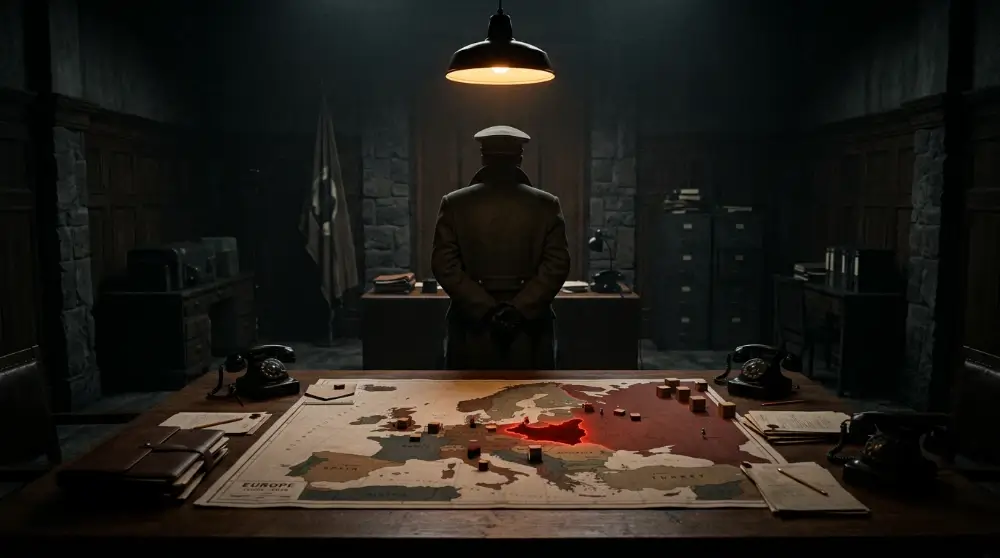

Imagine sitting in your living room in the late 1930s. The air feels different lately — heavier, charged with something that nobody can quite name.
Every time the radio crackles to life, one name dominates the broadcast: Adolf Hitler. Across Europe in 1939, hundreds of millions of people shared the same creeping dread — and none of them could fully explain why peace felt so close to breaking.
The relative calm of the interwar years was unraveling fast. Nations that had buried a generation in the trenches of the First World War were watching, horrified, as borders began to shift again — this time backed by tanks, bombers, and the ideology of racial empire.
This fear was not abstract or distant. It lived at kitchen tables, in whispered conversations on train platforms, in the faces of parents watching their children play outside.
Streets across Europe carried the same quiet weight. Smiles grew thinner. Newspapers grew darker.
The world desperately wanted to avoid repeating the catastrophe of 1914. But behind the public anxiety, the machinery of an even more devastating conflict was already in motion — and one nation was already in the crosshairs.
In this article, we trace the start of World War II — examining the invasion of Poland in 1939 and the cascade of decisions that plunged the world into six years of catastrophic war.
At the center of this story stands a single moment: one order, given in one room, by one man — and the world that changed forever because of it.
Table of Contents
Europe in 1939: A Continent Gripped by Fear
Europe stood on the edge of a precipice. Every nation could feel the ground shifting beneath its feet.
The atmosphere before the war
By 1939, the scars of the Great War were barely two decades old. Entire families across Britain, France, Germany, and Poland had lost sons and fathers to the trenches — and no one had forgotten the cost.
Whole communities still carried that grief forward. A second catastrophe was not merely feared; for many who had lived through the first, it felt almost unthinkable.
The fear was not only political. It was deeply personal — lived in the body, felt in the chest every time a radio broadcast began with news from Berlin.
Across the continent, in market squares and train stations and sitting rooms, the same desperate plea was exchanged in every language.
“Please. No more war.”
That simple sentence captured the collective mood of an entire civilization. People could sense, even without knowing the precise details unfolding in Berlin’s war rooms, that peace was slipping away.
Hitler’s rise had made that fear concrete and specific. With every territorial move — Austria in 1938, Czechoslovakia by March 1939 — the horizon grew darker and the window for diplomacy grew narrower.
Why the tension mattered
This was far more than a diplomatic dispute between governments. The atmosphere of 1939 represents the final, critical convergence of the causes of World War II — ideology, unchecked aggression, and the slow collapse of collective security.
Appeasement had repeatedly rewarded expansion. Leaders in London and Paris had hoped that meeting Hitler’s demands would satisfy him. After Munich in 1938, they learned how deeply wrong that calculation was.
Militarism surged across Europe as other nations scrambled to prepare. The window for peaceful resolution was closing by the week, then by the day.
Every silence from the Western powers emboldened the next act of aggression. Every concession moved the continent one step closer to the edge.
By the summer of 1939, Europe was not merely observing history. It was living through its final hours of peace before the start of World War II.
Why Poland Became the Target
The next escalation required a target. For Hitler, that target had been identified long before the summer of 1939.
A calculated act of expansion
The invasion of Poland in 1939 was not impulsive. It was the product of months of meticulous military planning, ideological conviction, and cold diplomatic maneuvering.
Hitler’s ambitions had been written plainly in his own words for years. He wanted territory, resources, and domination over Eastern Europe — goals rooted in the Nazi concept of Lebensraum, the idea that the German people required additional “living space” to survive and expand as a nation.
Poland’s geography made it an obvious first step. It sat between Germany and the vast territories to the east that Nazi ideology coveted, and the Polish Corridor — a strip of land separating Germany from East Prussia — had long been a source of bitter resentment since the Treaty of Versailles.
To eliminate the risk of Soviet intervention, Germany and the USSR signed the Molotov–Ribbentrop Pact on August 23, 1939. Behind its public face of non-aggression lay a secret protocol quietly dividing Eastern Europe between the two powers — and sealing Poland’s fate.
With the Soviet threat removed, Hitler turned his full strategic attention to Warsaw. He calculated that Britain and France, having backed down at Munich, would hesitate again before honoring their guarantees to Poland.
To manufacture a justification for the world, SS officers staged the Gleiwitz incident on the night of August 31 — disguising themselves as Polish soldiers, seizing a German radio station, and broadcasting a provocation to make Poland appear the aggressor.
The deception was transparent and unnecessary. By dawn the following morning, the lie would be buried under the noise of actual bombs — and the world would understand exactly what had happened.
September 1, 1939: The Invasion of Poland Begins
The date September 1, 1939 is one of the most consequential in modern history. Everything that came before it was prologue. Everything after it was war.
The morning that changed everything
At 4:45 AM, the German battleship Schleswig-Holstein opened fire on Polish fortifications at Westerplatte, near the port city of Danzig. Those were the first cannon shots of the Second World War.
Within minutes, German aircraft filled the sky above Polish cities. More than 900 bombers and 400 fighter planes struck military installations, airfields, and civilian infrastructure simultaneously.
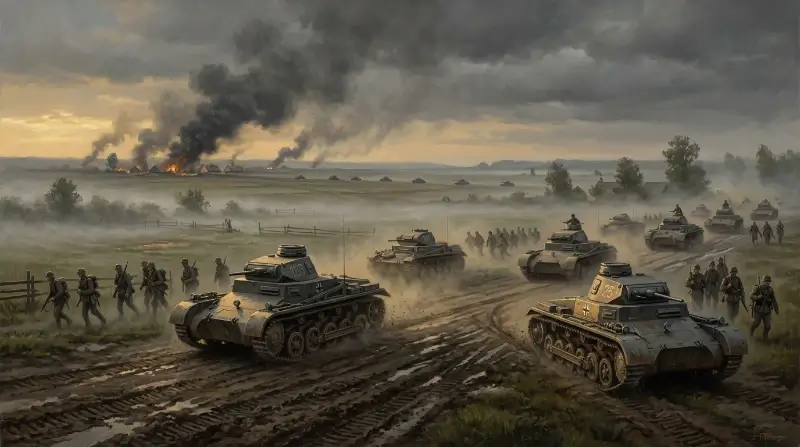
On the ground, over 60 divisions and nearly 1.5 million soldiers crossed Poland’s borders from the north, west, and south in a coordinated encirclement. Polish defenders had no time to form coherent lines of resistance.
The scale of the assault was designed to overwhelm — not just militarily, but psychologically. The invasion of Poland in 1939 was not a border skirmish. It was a total campaign aimed at destroying a nation in a matter of weeks.
By the time the sun had risen fully over Warsaw, the start of World War II was no longer a fear. It was a fact.
Blitzkrieg and shock
The invasion introduced the world to a terrifying new form of modern warfare — Blitzkrieg, or “lightning war.” Speed was the primary weapon, and total shock was the intended effect.
Air strikes hit Polish airfields and communication networks first, shattering any organized defensive response before it could form. Armored Panzer divisions immediately followed, driving deep into the country before defenders could regroup.
Infantry advanced in precise waves behind the armored spearheads. For Polish soldiers and civilians alike, the pace of collapse was almost impossible to process in real time.
Communities that had woken to normal morning routines found themselves inside a war zone before breakfast ended. Work, school, markets — everything ceased in an instant.
Nothing in Poland’s experience had prepared it for this scale, this speed, or this ferocity of assault.
Quiet villages
Farming communities that had seen nothing but open fields and ordinary seasons became active battlegrounds within the hour. Villages that were silent at sunrise were burning by mid-morning.
Screaming planes
The wail of Junkers Ju 87 Stuka dive-bombers replaced the sounds of morning across Polish cities and towns. That shrieking engine note became one of the defining sounds of the entire Second World War.
Explosions and fear
Roads shattered under bombardment. Families fled on foot, carrying what they could, with no clear destination and no way to know where safety might exist.
This was the terrifying new face of modern industrial war — engineered not just to defeat an army, but to shatter the will of an entire people within days.
The Domino Effect: Britain and France Enter the War
The invasion of Poland did not remain a regional event. Allied governments had been watching Hitler’s every move for months — and this time, there would be no more negotiating.
Two days that changed the world
Hitler had gambled on hesitation — convinced, as he had been during the annexation of Austria and Czechoslovakia, that Britain and France would ultimately find a reason to stand aside.
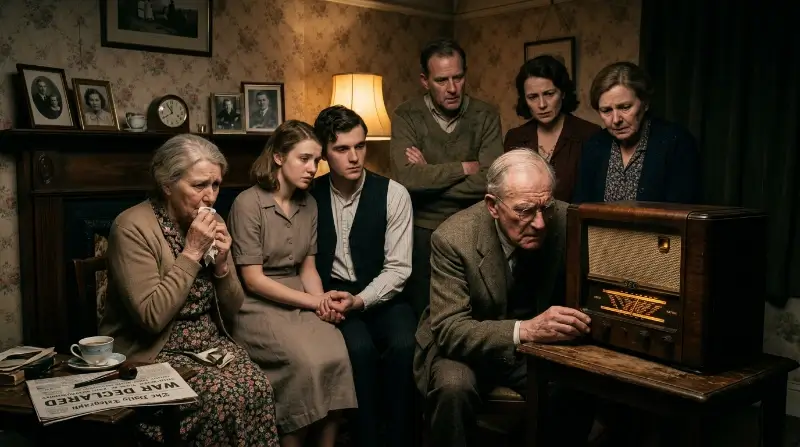
He was wrong. On the morning of September 3, 1939, Prime Minister Neville Chamberlain broadcast to the British nation at 11:15 AM: “This country is at war with Germany.” France issued its own declaration just hours later.
That broadcast — heard by millions of families gathered around wireless sets in living rooms across Britain — transformed a bilateral invasion into the full start of World War II. The conflict was now global in scope and impossible to contain.
Poland had been the first domino. Once it fell, the chain reaction moved with a speed that no diplomat could match and no treaty could stop.
War expanded across Europe within weeks. Within years, it would stretch to North Africa, the Pacific, and the heart of every inhabited continent on earth.
The decision to invade Poland had opened a door that only six years of catastrophic destruction would finally close — at an almost unimaginable cost.
One Man, One Room, Millions of Dead
Behind the thunder of the Blitzkrieg, behind the declarations of war and the collapse of entire nations, there was a simpler and more devastating truth.
The most sobering truth of the war
The entire cascade of destruction that followed September 1, 1939 — from the burning cities of Western Europe to the death camps built on occupied Polish soil — began with a single decision made by a single man.
World War II would ultimately claim an estimated 70 to 85 million lives. Families were erased from history. Cities that had stood for centuries were reduced to ash. Entire peoples were targeted for systematic annihilation.
Numbers alone cannot hold the weight of this loss. Behind every statistic was a living person — a child, a parent, a neighbor, someone’s entire world.
The deeper tragedy lies not in the scale but in the structure of what happened. A chain of decisions — each one reversible, each one a choice — led here. And then, suddenly, there were no more choices left to make.
How many of those 70 million lives could have been saved if a different decision had been made in that room on the morning of September 1, 1939?
That question has no comfortable answer. But it is one that every generation inherits from the last — and one that history will not allow us to stop asking.
Key Lessons from the Start of World War II
The events of 1939 are more than a chapter in a history textbook. They carry lessons that remain urgently relevant in any era where power goes unchecked and diplomacy loses its nerve.
1. Fear can signal collapse
The widespread fear that gripped Europe in 1938 and 1939 was not paranoia — it was an accurate reading of a political order approaching collapse. Public anxiety is often the earliest and most honest signal of deeper systemic instability.
2. The invasion of Poland changed everything
The invasion of Poland in 1939 was the point of no return — the specific moment when regional aggression became world war. It was not one event among many. It was the trigger that made the largest conflict in human history inevitable.
3. Escalation can happen with shocking speed
Only 48 hours separated the first German shell fired at Westerplatte from the declarations of war by Britain and France. Events moved far faster than diplomacy could track — a reminder that once certain thresholds are crossed, momentum becomes nearly impossible to reverse.
4. History is shaped by decisions
World War II was not a natural disaster. It was the cumulative product of choices — made by leaders with power, enabled by institutions that failed to resist them, and accelerated by those who chose silence when resistance was still possible.
Video Version
Watch the full visual breakdown of these events in the video below, which brings the history of 1939 to life with cinematic narration and historical context.
Conclusion: Remembering 1939
The start of World War II was not a sudden thunderclap from a clear sky. It was the culmination of years of unchecked ambition, failed diplomacy, and a continent too exhausted by the memory of one war to resist the approach of another.
The invasion of Poland in 1939 gave the world a brutal education in how quickly peace can be dismantled — and how catastrophically the consequences compound once total war begins.
History is never simply a list of dates and battles. It is the accumulated weight of human decisions — some made in grand halls of power, others in dark rooms at dawn, and all of them carrying consequences that outlast the moment of their making.
The decisions of 1939 reshaped the map of the world, the fate of nations, and the lives of tens of millions. Their echoes can still be felt in the borders, the politics, and the memorials that define Europe today.
Understanding how the war began — truly understanding it, beyond the dates — is one of the most important things we can carry forward. Peace is never permanent. It must be chosen, actively defended, and fought for in every generation.
Timeline: Key Dates in the Start of World War II
The start of World War II unfolded through a rapid sequence of decisions and betrayals, each one closing the door to peace a little further.
This timeline highlights the pivotal moments — from the signing of the Nazi–Soviet Pact to the final fall of Poland — that together form the complete story of how the invasion of Poland in 1939 ignited a global war.
- March 15, 1939 — Germany Occupies Czechoslovakia: After seizing the Sudetenland under the Munich Agreement in 1938, Germany violated the deal entirely by occupying the rest of Czechoslovakia. It was the clearest possible signal that appeasement had failed completely.
- August 23, 1939 — Nazi–Soviet Pact Signed: Germany and the Soviet Union signed a non-aggression pact in Moscow. Its secret protocol divided Eastern Europe into spheres of influence between two totalitarian powers — and sealed Poland’s fate before a single shot was fired.
- August 31, 1939 — The Gleiwitz Incident: SS officers disguised as Polish soldiers staged a false-flag attack on a German radio station near the Polish border, giving Hitler a manufactured justification to frame Poland as the aggressor before the invasion began.
- September 1, 1939 — Invasion of Poland Begins: At 4:45 AM, the German battleship Schleswig-Holstein opened fire at Westerplatte. More than 60 divisions and 1.5 million troops crossed Poland’s borders in a coordinated Blitzkrieg — marking the official start of World War II.
- September 3, 1939 — Britain and France Declare War: Prime Minister Neville Chamberlain broadcast Britain’s declaration of war at 11:15 AM, telling the nation: “This country is at war with Germany.” France followed within hours, transforming the invasion into a global conflict.
- September 17, 1939 — Soviet Forces Invade Eastern Poland: Acting on the secret terms of the Molotov–Ribbentrop Pact, Soviet troops invaded Poland from the east. Caught between two powers, Poland was now fighting on two fronts with no realistic hope of relief.
- October 6, 1939 — Poland Falls: After weeks of fierce but overwhelmed resistance, organized Polish military opposition ended. Germany and the Soviet Union divided the country between them, erasing Poland from the map of Europe.
This sequence shows with brutal clarity how rapidly a functioning peace can unravel. Within five weeks of the first German shell being fired, Poland had ceased to exist as an independent state — and Europe was fully at war for the second time in a generation.

Add your first comment to this post