
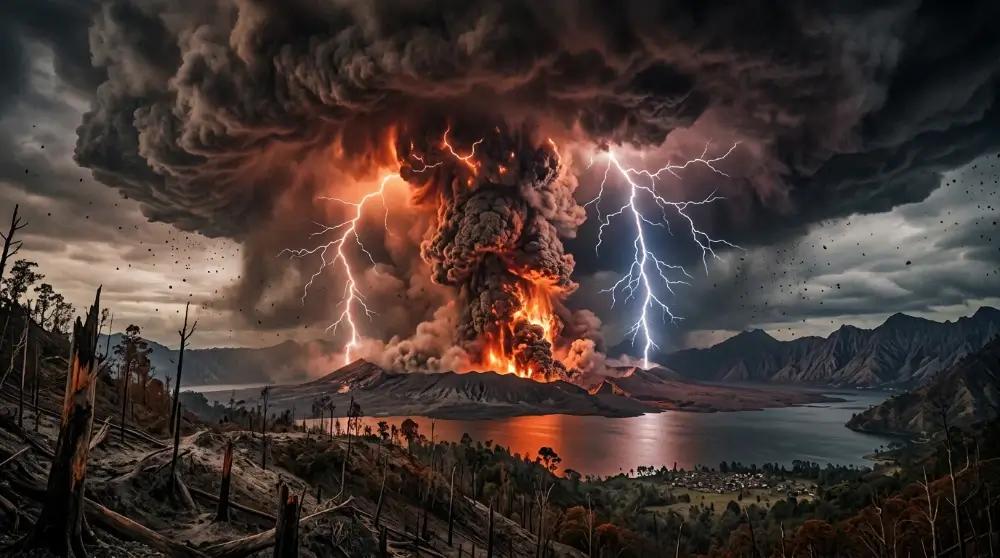

Today, there are 8 billion people walking the earth. We live in a world of sprawling megacities, interconnected global economies, and a population that seems unstoppable. But there was a moment deep in prehistory when the entire human species nearly fit inside a single valley. What almost erased us wasn’t a world war, a plague, or the slow grind of natural selection. It was a single morning, a single mountain, and a Toba Supervolcano eruption so violent it rewrote the human story forever.
Beneath the calm, impossibly blue waters of Lake Toba in the highlands of Sumatra lies a planetary wound. It is a scar that geologists can still measure today, marking the site of the most catastrophic volcanic event our species has ever witnessed. Around 74,000 years ago, the ground tore itself apart, plunging the world into darkness and bringing humanity to the very brink of a global human extinction event. This is the story of the Toba super-eruption — the moment we almost vanished, and the incredible legacy of the survivors who ensured we are here today.
Table of Contents
The Hidden Giant Beneath Lake Toba
If you visit northern Sumatra today, you will find a landscape of breathtaking beauty. Steep forested walls rise around a vast basin, enclosing a lake so large it creates its own miniature weather systems. At its center sits Samosir Island, a landmass so enormous it’s hard to believe it exists within a lake. To the local Batak people and the tourists who visit, it is a place of quiet, ancient calm.
However, the sheer scale of Lake Toba is the first clue to its violent past. This is not a standard lake; it is a flooded caldera — the remnant of a supervolcano that didn’t just erupt, but consumed itself. To understand how this happened, we have to look deep beneath the Indian Ocean. Here, the Indo-Australian tectonic plate is being forced under the Sunda plate in a process called subduction. This movement creates intense heat and pressure, melting rock and feeding a chain of volcanoes along Sumatra.
But Toba was different. For tens of thousands of years, exceptionally thick, silica-rich magma accumulated in a chamber tens of kilometers wide. This magma trapped dissolved gases, building pressure like a planetary-scale pressure cooker. The crust above began to dome upward, millimeters at a time, for generations — loading a geological spring that was destined to snap.
The Day the Toba Supervolcano Exploded
Around 74,000 years ago, the highlands of Sumatra were a lush, prehistoric paradise. Stegodons — ancient elephant-like creatures — grazed in the undergrowth, and clouded leopards stalked the canopy. Among them were small bands of early Homo sapiens. These were people much like us — lean, strong, and deeply in tune with the rhythms of the forest. They had no way of knowing that the ground beneath them had been building toward a cataclysm for 100,000 years.
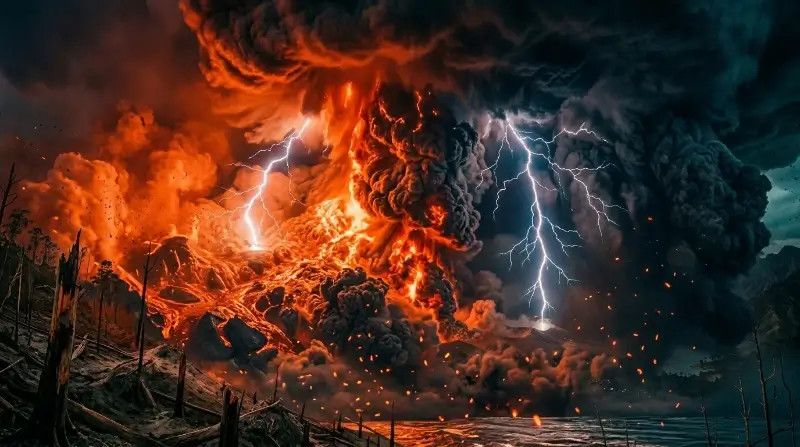
When the Toba Supervolcano eruption finally began, it didn’t start with a roar, but with a fracture. As the roof of the magma chamber gave way, the transition from equilibrium to catastrophe took mere minutes. The mountain didn’t just erupt; it disintegrated. A column of pulverized rock, ash, and superheated gas shot 40 kilometers into the sky, punching through the atmosphere with the sound of a continent-wide explosion.
The Immediate Aftermath: Fire, Ash, and Total Darkness
The eruption unleashed three overlapping catastrophes in rapid succession — each more lethal than the last.
Pyroclastic Surges
Rivers of incandescent gas and rock poured over the crater rim at the speed of a highway vehicle, vaporizing everything in their path. These pyroclastic flows snapped trees, scoured valleys, and erased entire ecosystems in minutes. Nothing within range survived.
Ash Rain
Ash was ejected at a rate of tens of millions of tons per second. What started as a gray dusting soon became a choking storm that turned rivers into thick paste, collapsed shelters, and buried the landscape beneath meters of volcanic debris. Breathing became an act of survival in itself.
A World Without Sun
The sun was blotted out by a cloud of ash and sulfur that stretched across the horizon, turning day into a permanent, smoldering night. For those who survived the initial blast, the real nightmare was only beginning.
From Eruption to Volcanic Winter: A Global Climate Shock
The destruction in Sumatra was total, but Toba’s reach was global. In the weeks that followed, ash drifted across South and Southeast Asia, eventually settling in layers that geologists still find today in India and on the ocean floor. However, the most devastating impact came not from the ash, but from the stratosphere.
Fine sulfur dioxide particles remained suspended in the upper atmosphere, forming a semi-transparent veil that reflected sunlight back into space. This triggered a volcanic winter. Global temperatures plummeted by several degrees, growing seasons shrank or vanished, and rainfall patterns shifted drastically. In a world without grocery stores or agricultural surpluses, early humans lived directly off the land. When the land “switched off,” the consequences were immediate and lethal.
The Genetic Bottleneck: When Humanity Almost Disappeared
We know the severity of this event not just from rocks, but from the code written inside every living human being. Scientists studying human DNA have identified a dramatic genetic bottleneck that occurred roughly 74,000 years ago. The genetic evidence suggests that the total number of breeding humans on Earth may have dropped to just a few thousand individuals worldwide.
This period represents a catastrophic narrowing of the gene pool. Countless human lineages — groups that had thrived for tens of thousands of years — simply ended. The rest of us are the descendants of a tiny, resilient group of survivors who endured the unendurable. Whether they survived by huddling around small fires in rock shelters or by finding rare refuges where plants still grew, their survival is the reason our species exists today.
In other words, the Toba Supervolcano didn’t just shape a landscape. It reshaped who we are.
The Scientific Debate: How Deadly Was the Toba Event?
While the eruption and the population bottleneck are supported by geological and genetic evidence, scientists continue to debate the exact link between the two. Some researchers argue that Ice Age climate was already unstable, and that Toba was simply the final “push” that broke the system. Others believe the Toba Supervolcano was the primary driver of the crisis.
Regardless of the nuance, the consensus remains: around 74,000 years ago, humanity faced one of the greatest survival tests in its history — an almost unimaginable human extinction event driven by a single volcano.
Key Lessons from the Toba Supervolcano
The Toba event offers four enduring lessons that remain relevant far beyond geology.
1. Geological Scale Beyond Human Experience
Lake Toba is a reminder that the Earth operates on a scale far beyond human timelines. What looks like a peaceful lake is actually a dormant supervolcano caldera — the scar of one of the largest eruptions in the last two million years.
2. Human Resilience Under Extreme Pressure
Our species survived a multi-year climatic collapse with nothing but stone tools, deep knowledge of the land, and communal bonds. The Toba survivors show how adaptable and resilient prehistoric humans could be in the face of global disaster.
3. The Bottleneck Effect in Our DNA
Modern humans are genetically very similar because we all descend from the small group of Toba survivors. The bottleneck effect still shapes patterns of disease, diversity, and evolution today.
4. Modern Vulnerability to a New Volcanic Winter
While the probability of another Toba-scale eruption is low in any given century, the Toba event serves as a “recalibration of scale.” In our modern, interconnected world, even a smaller volcanic winter would pose an unprecedented threat to global food systems, trade, and stability.
Conclusion: A Legacy Written in Ash and DNA
The caldera of Toba is still there, filled with rainwater and surrounded by life. The geological forces that created it — the subduction of tectonic plates — remain active. While geologists monitor the site closely, the true story of Toba isn’t just about the threat of future eruptions; it’s about the incredible endurance of the human spirit.
We are the children of the ash. Every person alive today carries the signature of those few thousand ancestors who saw the sky turn gray, felt the world grow cold, and refused to let the fire of humanity go out. It is a humbling reminder that while we may dominate the planet today, we once nearly fit inside a single valley, waiting for the sun to return.

Add your first comment to this post