
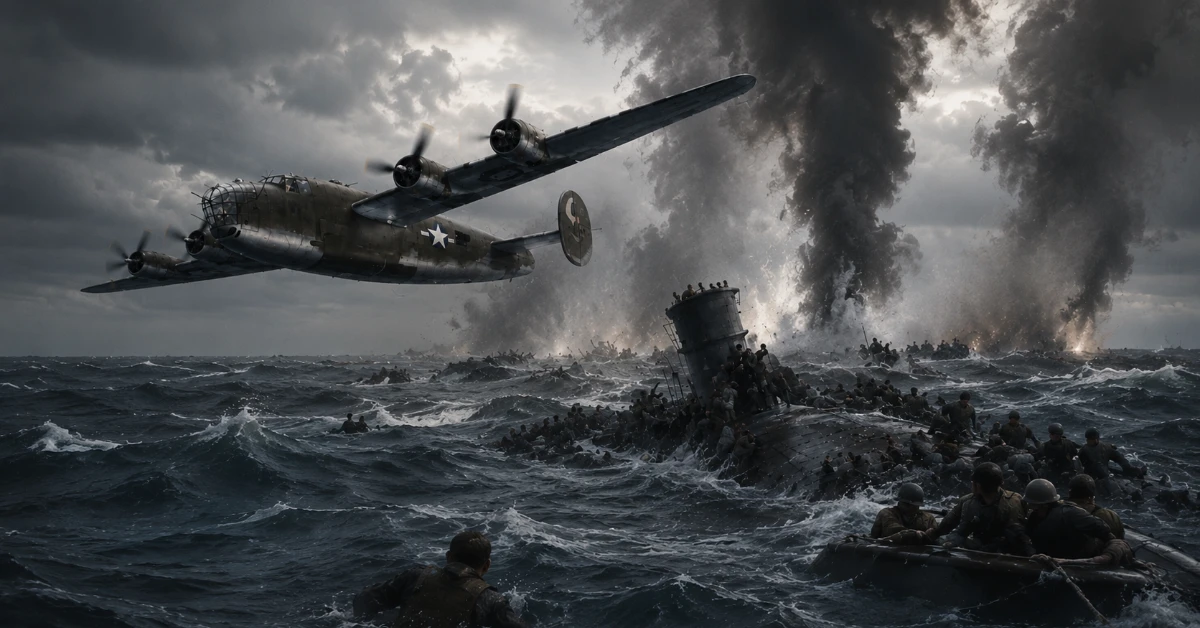

Nineteen-year-old Royal Navy Able Seaman Tony Large was in a lifeboat when the bomb hit. The date was September 16, 1942: the laconia incident’s worst hour.
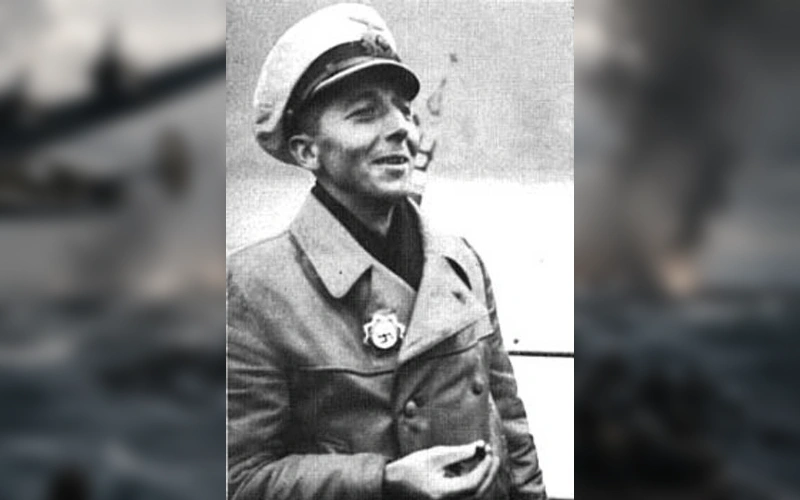
He’d already survived the sinking of HMS Cornwall in December 1941. Now he was in the South Atlantic, his lifeboat towed behind a German submarine that had stopped to pull survivors from the torpedoed troopship RMS Laconia. The submarine was surfaced. A handmade Red Cross banner hung across its gun deck. The commander, Werner Hartenstein of U-156, had broadcast his position on open, uncoded radio in English, promising not to attack any ship that came to help.
An American B-24 Liberator appeared overhead and attacked anyway.
The blast threw Large into the sea. He clawed his way back into the lifeboat; many around him didn’t: they drowned or were taken by sharks. Hartenstein cut the tow lines, ordered everyone off his deck, and crash-dived to protect his submarine. Tony Large and 51 other men were alone in the Atlantic, 700 miles from shore, with three gallons of drinking water between them.
In 1993, the U.S. Defense Department reviewed what had happened and concluded that a war crime had been committed, not by the enemy, but by American command.
Table of Contents
Key Takeaways
- RMS Laconia was torpedoed by U-156 on September 12, 1942, with more than 3,000 people aboard — including 1,800 Italian prisoners of war confined below decks.
- German commander Werner Hartenstein launched a three-day open rescue, broadcasting his position in English and flying Red Cross flags alongside three Allied submarines.
- On September 16, USAAF Captain Robert C. Richardson III ordered Lieutenant James D. Harden to bomb U-156 during the active rescue, killing an estimated 100 survivors directly.
- Survivor Tony Large spent 39 days adrift in a lifeboat after the bombing — one of only 4 of 52 men to survive.
- Admiral Karl Dönitz issued the Laconia Order on September 17, 1942, forbidding U-boat crews from rendering any assistance to survivors of ships they sank.
- In 1993, the U.S. Defense Department concluded that Richardson and Harden bore prima facie responsibility for a war crime. Neither was ever charged.
The Ship and the People Inside Her
RMS Laconia was launched in 1921 by the Cunard Steamship Company and became, in 1923, the first passenger ship to complete a full circumnavigation of the globe. By 1942, the Royal Navy had stripped out her passenger fittings and pressed her into service as a troopship. In September of that year she sailed from Cape Town toward Plymouth under the command of Captain Rudolph Sharp, a man who had already survived catastrophe, having commanded the Lancastria when Luftwaffe bombers sank her in June 1940 during the evacuation from France.
Her passenger manifest that voyage was unusual. Aboard were more than 3,000 people: approximately 1,800 Italian prisoners of war captured in Libya, roughly 400 Polish soldiers assigned to guard them, 80 British civilians who were mostly dependents of military personnel, and around 400 crew members. The Italian POWs had been confined below decks and were expected to remain there until all Allied personnel were safely away.
September 12, 1942: Two Torpedoes in the Dark
At approximately 10:22 p.m. on September 12, 1942, U-156 found the Laconia roughly 900 miles northwest of Ascension Island and put two torpedoes into her. The impact drove the ship into a heavy list, making it impossible to launch half her lifeboats. As she went down, Polish guards prevented the Italians from boarding the boats that had been deployed. Many jumped into water already churned with wreckage and sharks.
When U-156 surfaced expecting to identify senior officers for interrogation, Commander Hartenstein found more than 2,000 people fighting to stay alive in the dark.
Werner Hartenstein Declares a Rescue
What Hartenstein did next had no precedent in the Atlantic campaign.
He ordered his crew to begin pulling survivors aboard. His submarine, built for a crew of roughly 44, took on hundreds of people, crammed on deck and below. He rigged a Red Cross banner across the gun deck, a large white bedsheet daubed with the international distress symbol. The emblem was recognized under the Hague Conventions as protection for vessels engaged in mercy operations, a legal framework recognized as binding on all belligerent nations.
Three Days the Atlantic War Stopped
By September 14, two other German U-boats and the Italian submarine Comandante Cappellini had arrived, all flying Red Cross flags and all pulling survivors from the sea. Vichy French naval vessels were dispatched toward the coordinates. Hartenstein broadcast openly in uncoded English, giving his exact position and promising not to attack any ship that came to assist.
For three days, the rescue operated in the open. German and Italian submarines towed lines of British lifeboats. Enemies shared rations on the deck. The Laconia incident, for that brief window, produced the Atlantic war’s strangest scene: men who had been shooting at each other’s ships treating each other’s wounds.
Then, on September 16, an American B-24 Liberator appeared on the horizon.
The Order to Attack: Captain Richardson and Lieutenant Harden
Lieutenant James D. Harden, flying from the Ascension Island air base, spotted U-156 from altitude. Survivors were visible on deck. The Red Cross banner was visible from altitude. Hartenstein sent a radio message in English identifying the rescue operation and asking for assistance.
Harden reported back to his commanding officer and waited.
Captain Richardson’s Decision
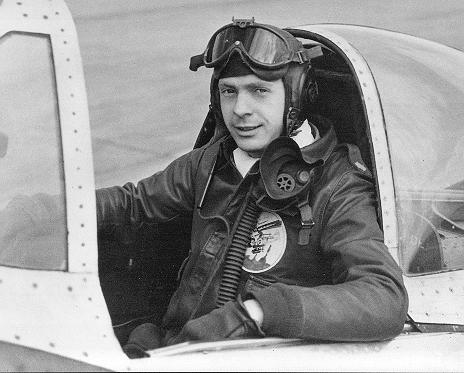
Captain Robert C. Richardson III, the senior USAAF officer at Ascension, ordered the submarine attacked. He later said he hadn’t been fully briefed on the rescue’s scope. He expressed concern that the Red Cross flag was a deception: the U-boat might be luring Allied ships into torpedo range, or gathering intelligence on the Ascension Island base, whose existence the Americans were determined to keep secret. Some accounts suggest he also concluded that the survivors visible on deck were Italian POWs, not British personnel.
Harden made his bomb run. The explosions killed an estimated 100 survivors directly. One detonated within 10 feet of Tony Large’s lifeboat. Hartenstein cut the tow lines, ordered his deck cleared, and dove.
Harden’s crew returned to Ascension Island and filed a mission report stating they had sunk the U-boat. They had not. Both Harden and members of his crew were awarded Air Medals for the mission.
The mission those medals recognized had sunk lifeboats.
Laconia Incident Survivors: Tony Large’s 39 Days Adrift
Fifty-two men crowded into Tony Large’s lifeboat after the bombs. Three gallons of water. Seven hundred miles from land.
The men fished using bent nails bent into hooks. Their thirst became so severe that they drank the blood from whatever fish they caught and sought moisture from the eyeballs. For seventeen days, that was enough to keep most of them alive. Then, on day 17, a northbound cargo freighter passed within 300 yards of the lifeboat. The men screamed. They waved everything they had. The freighter did not slow. Its crew apparently never looked.
Tony Large later wrote about that moment in his letter home, recorded in his memoir In Deep and Troubled Waters (Paul Watkins, 2001): “This was the bitterest blow of all.”
Day 17: The Freighter That Did Not Stop
Within four days of the freighter’s passing, 43 of the 52 men were dead. Those who had given up stopped eating, stopped moving, or quietly slipped over the side. One of Large’s friends, a man Tony had known well enough to notice his silences, climbed over the rail during the night and paddled away to his death. Large wrote afterward that he hadn’t recognized the depth of the man’s despair clearly enough to stop him.
It rained eventually. The water kept four of them alive a few more days. Five of those remaining nine still died from what 39 days of exposure and starvation had already done to their bodies.
On day 39, the escort vessel St. Wistan spotted two figures sitting upright in the lifeboat. When Large tried to wake the two sleeping men, they refused to sit up or even look toward the ship. They’d been disappointed too many times to risk hoping again. All four were pulled aboard. They had drifted more than 600 miles from where the bombs had fallen.
Doris Hawkins: 27 Days Adrift
A second survivor, British nurse Doris Hawkins, spent 27 days adrift in a lifeboat before reaching the coast of Liberia. Throughout those days she cared for the injured, watched people die around her, and held the personal effects of those who didn’t make it, which she carried home to deliver to their families after the war. She then visited those families herself. Stories like hers belong to a category of wartime experience that official records rarely preserved with care, a problem shared by other overlooked figures such as Soviet aviator Nadezhda Popova and the Night Witches, whose 852 combat missions went unrecognized by Allied nations for decades.
Of the more than 3,000 people who had been aboard RMS Laconia, between 976 and 1,083 survived. Between 1,658 and 1,757 died; the majority were Italian prisoners of war, most killed not by the original torpedo but by the collapse of the rescue.
The Verdict America Issued Against Itself
Dönitz responded on September 17, 1942, the day after the attack. His order, which became known as the Laconia Order, forbade U-boat crews from rendering any assistance whatsoever to survivors of ships they sank: no food, no water, no directions to the nearest coast. Before the laconia incident, small gestures of maritime humanity had survived in the Atlantic war. After it, Dönitz eliminated them by regulation.
The Laconia Incident at Nuremberg
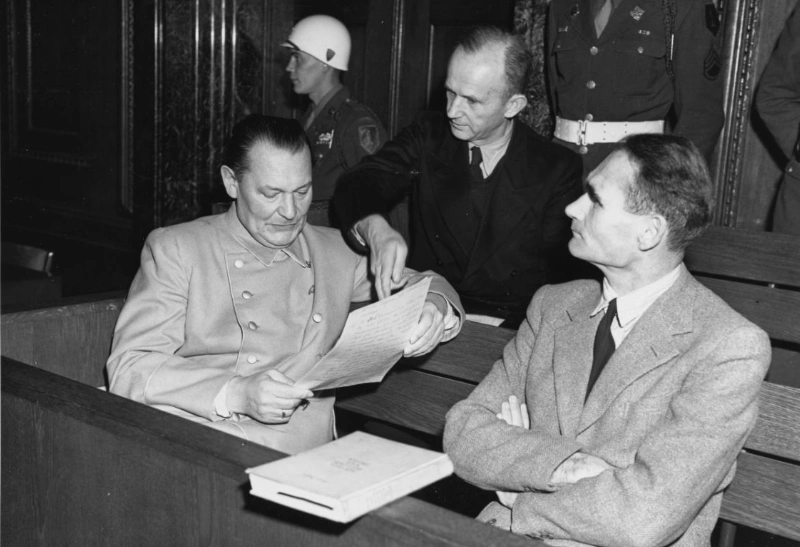
At the Nuremberg trials, Allied prosecutors attempted to use the Laconia Order as evidence of criminal intent against Dönitz. The defense produced the full record of the laconia incident, including the American attack on submarines flying Red Cross flags during a documented rescue. The prosecution’s position became untenable. When U.S. Fleet Admiral Chester W. Nimitz was asked to provide context on submarine conduct, he confirmed that the United States had practiced unrestricted submarine warfare in the Pacific from the first day it entered the war. The tribunal criticized the Laconia Order but declined to convict Dönitz on that specific count.
The Pentagon’s 1993 War Crime Finding
The institutional reckoning came fifty years later. In 1993, the U.S. Defense Department published a series of International Law Studies examining how the rules of war had been applied across World War II. Its conclusion about the laconia incident was precise: both the officer who issued the order and the pilot who carried it out bore prima facie responsibility for a war crime under the laws then in force.
Richardson and Harden were never charged. Both died long before that finding was published. Hartenstein, for his part, received the Knight’s Cross for his actions during the rescue, then died on March 8, 1943, when an American aircraft sank U-156 off Barbados.
The pattern the laconia incident revealed, official orders requiring individuals to override every instinct toward mercy, did not stop in 1942. German pilots faced their own version of it in April 1945, when the Sonderkommando Elbe ramming mission ordered them to destroy Allied bombers with their own aircraft. In both cases, the men at the bottom of the command chain were asked to bear the moral weight of decisions made at the top.
Tony Large survived 39 days because he refused to stop surviving. The DoD finding that the act which put him there constituted a war crime sits in the historical record without legal consequence. Richardson received recognition before the verdict came. Large received none. The gap between those two facts is where the laconia incident still lives.
Frequently Asked Questions
What was the Laconia Incident?
The Laconia Incident refers to the events following the torpedoing of British troopship RMS Laconia by German submarine U-156 on September 12, 1942. Commander Werner Hartenstein subsequently launched an open rescue operation, towing lifeboats and broadcasting his position in English under Red Cross flags. On September 16, a U.S. Army Air Forces B-24 Liberator bombed U-156 during the rescue, killing an estimated 100 survivors and forcing the abandonment of the remaining lifeboats. The attack led directly to the Laconia Order, which ended U-boat rescue practices for the rest of the war.
Who ordered the attack on U-156 during the Laconia Incident?
Captain Robert C. Richardson III, the senior USAAF officer at Ascension Island, ordered Lieutenant James D. Harden to attack U-156 on September 16, 1942. Richardson later stated he had not been fully briefed on the rescue’s scope and feared the surfaced submarine posed a strategic risk to the Ascension Island air base. Harden’s crew was subsequently awarded Air Medals for the mission.
Was the Laconia Incident a war crime?
In 1993, the U.S. Defense Department’s International Law Studies series concluded that both the officer who issued the order to attack and the pilot who carried it out bore prima facie responsibility for a war crime. Under the laws of war in force at the time, vessels engaged in rescue operations under Red Cross protection were not lawful targets. Neither Richardson nor Harden was ever charged; both had died by the time the finding was published.
What was the Laconia Order?
The Laconia Order was issued by Admiral Karl Dönitz on September 17, 1942 — the day after the American attack on U-156. It forbade German U-boat crews from rendering any assistance to survivors of ships they sank, including food, water, medical aid, or directions to the nearest coast. Before the Laconia Incident, small acts of maritime humanity had persisted in the U-boat war; the order eliminated them by regulation and remained in force for the rest of the conflict.
How many people survived the sinking of RMS Laconia?
Between 976 and 1,083 people survived out of more than 3,000 aboard. Between 1,658 and 1,757 died. The majority of the dead were Italian prisoners of war — most had been confined below decks when the torpedoes struck and were left without rescue when the operation collapsed following the American air attack on September 16.

Add your first comment to this post