
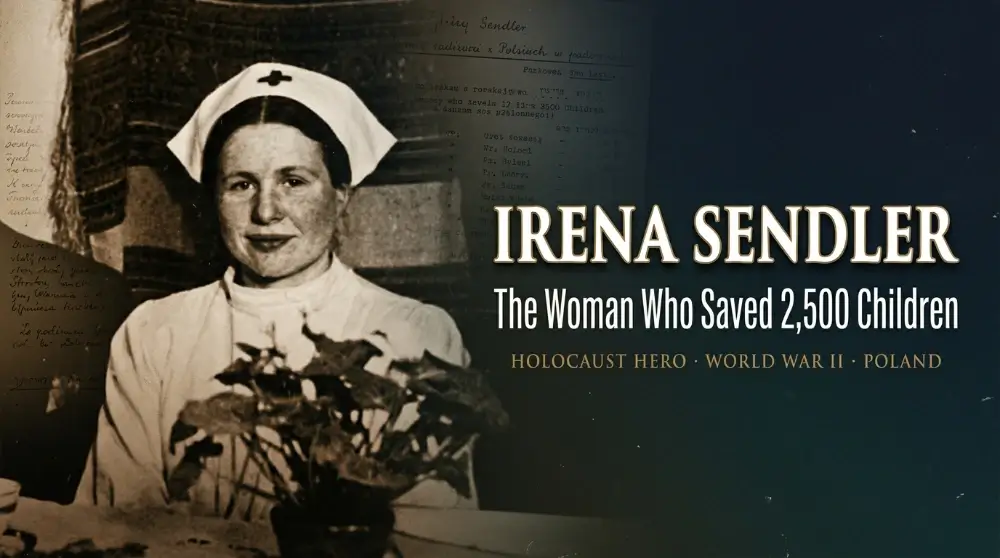

Irena Sendler was a Polish social worker who helped rescue around 2,500 Jewish children from the Warsaw Ghetto during World War II by smuggling them out, giving them new identities, and hiding them in safe homes. She coordinated these efforts through the underground Zegota network, carefully recorded children’s real names in secret lists, and survived arrest and torture by the Gestapo without revealing a single child or collaborator. Her biography stands as one of the clearest examples of quiet moral courage in the history of the Holocaust.
Table of Contents
Who Was Irena Sendler
Irena Sendler (1910–2008) was a Catholic Polish social worker who turned her profession into a shield for the most vulnerable victims of Nazi persecution. On paper she was a municipal employee working with families in crisis. In reality she became one of the central figures in the rescue of Jewish children from the Warsaw Ghetto.
In Holocaust history, Irena Sendler is not remembered for speeches or military victories, but for thousands of small, dangerous decisions made in stairwells, hospital corridors, and hidden rooms. While Nazi law tried to define who was worthy of life, she quietly refused that definition and chose to treat every child as her own responsibility.
Early Life and the Making of a Conscience
Irena Sendler was born on 15 February 1910 in Poland, into a Catholic family whose values shaped her more deeply than any later ideology. Her father was a doctor who treated poor Jewish patients when others refused. From him, Irena Sendler learned that a human being is not a problem to be categorized, but a person to be helped
As a student, she encountered antisemitism long before the German invasion. Anti-Jewish policies and social pressure in academic settings disturbed her deeply. Instead of adapting to the prejudice around her, she chose to oppose it in quiet ways, standing with Jewish classmates rather than accepting segregation as a normal fact of life.
These early experiences built the inner compass she would later follow. When Nazi law declared Jews subhuman and ordered society to participate in their exclusion, Irena already knew that law and morality are not always the same. That recognition prepared her to resist when resistance became deadly.
Historical Context: The Warsaw Ghetto and the Holocaust in Poland
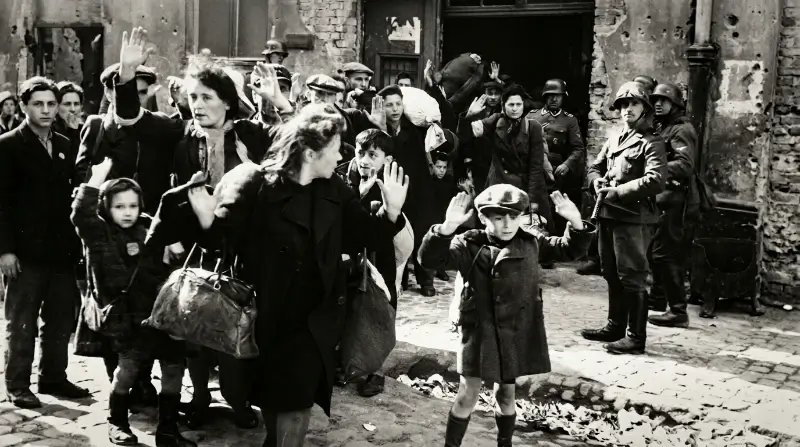
After Nazi Germany invaded Poland in 1939, Jewish life was rapidly destroyed through a mix of decrees, violence, and systematic dispossession. In Warsaw, the occupying authorities created the Warsaw Ghetto, enclosing hundreds of thousands of Jews behind walls and barbed wire in a small, overcrowded area of the city.
Conditions inside the ghetto were brutal. Food rations were far below survival level, housing was packed beyond reason, and medical care was almost nonexistent. Hunger, disease, and despair claimed many lives even before deportations began. For the Nazi regime, the ghetto was not a shelter but a waiting room for mass murder.
From the Warsaw Ghetto, Jews were deported to extermination camps, especially Treblinka, where most were killed soon after arrival. In this context, helping Jews was not simply illegal; it was treated as a capital offense. To feed a child, to hide a family, or to forge a document was to step deliberately into the path of a state that had legalized genocide.
Irena Sendler’s Path into the Resistance
Before the war, Irena worked as a social worker in Warsaw, serving families affected by poverty and social hardship. She knew the city’s streets, institutions, and informal networks, and she understood how to move through bureaucracy to get help where it was needed.
When Nazi occupation transformed Warsaw, Irena used her experience and contacts in a new way. As anti-Jewish policies hardened into deportations and ghettoization, she became involved with the underground resistance. One of the most important organizations she worked with was Zegota, the Council to Aid Jews, created explicitly to support Jews under Nazi rule.
Within Zegota, Irena specialized in saving children. She coordinated contacts with priests, nuns, doctors, and ordinary Polish families willing to hide Jewish children despite the risk of execution. Her role combined logistics, persuasion, and constant risk management. It was not enough to remove children from danger; she also had to keep them alive and hidden for an unknown length of time.
How Irena Sendler Rescued Jewish Children
Gaining Access to the Warsaw Ghetto
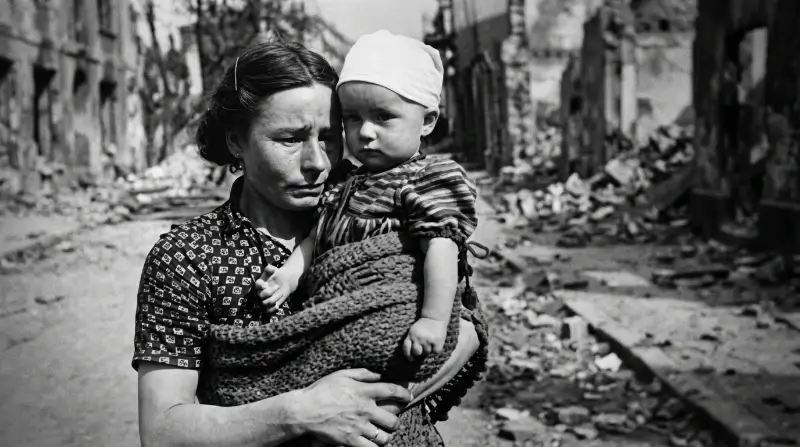
Irena’s position as a social worker and health official gave her limited permission to enter the Warsaw Ghetto under the pretext of inspecting sanitation and controlling disease. The Nazis feared that epidemics might spread beyond the ghetto and disrupt their own plans, so they allowed certain workers to pass in and out.
Irena used this narrow official permission as a moral back door. Each visit was a mixture of genuine welfare work, quiet observation, and careful preparation. In cramped apartments and crowded courtyards, she met parents who feared for their children’s lives. With them she discussed a possibility that felt almost impossible: sending their children away into the unknown, with strangers, as the only real chance of survival.
Methods of Smuggling Children Out
There was no single method that worked for every child, so Irena and her collaborators constantly adapted their tactics. Some of the methods described by witnesses and later accounts include:
- Carrying babies and very young children out of the ghetto hidden in boxes, tool chests, or bags that looked like ordinary parcels.
- Concealing children in vehicles such as ambulances or service cars that had routine access across ghetto boundaries.
- Guiding older children through back doors, side gates, and less-guarded passages, often relying on timing and distraction to avoid detection at checkpoints.
Every operation required precise coordination. A child needed to be taken from their family, moved across guarded lines, and received immediately on the other side by someone who knew exactly what to do next. A single mistake, a cry at the wrong moment, or a suspicious glance from a guard could lead to arrest and death for everyone involved.
Hiding Identities and Placing Children in Safe Homes
Escaping from the ghetto was only the beginning. Once outside, the children’s Jewish identity made them targets in a society policed by racial laws. To protect them, Irena and her network:
- Created false identity papers that gave each child a Polish, non-Jewish name.
- Placed children in Catholic convents and orphanages that agreed to accept them as boarders, novices, or abandoned children.
- Arranged for families in Polish neighborhoods to take children in as foster sons and daughters, often pretending they were distant relatives from other regions.
- Taught older children basic Catholic prayers, responses, and customs so that if they were questioned or observed, their behavior would match their assumed identity.
These new identities were not disguises for a few days. No one knew when the war would end. Families and institutions that welcomed these children had to commit for the long term, living under constant fear that a neighbor might inform or that a sudden search might reveal the truth.
The Secret Record-Keeping System for Reunions
Irena understood that changing a child’s name and religion, even for the sake of saving that child’s life, created a deep wound in their personal history. She did not want those children to disappear forever from their own families’ story. To prevent that, she devised a secret record-keeping system.
For each child, she recorded:
- The original Jewish name.
- Names of parents or close relatives.
- The new identity and the location where the child was hidden.
These notes were not stored in an office or a visible archive. They were hidden, coded, and concealed so that if the Gestapo discovered them, they could not easily use the information to arrest the children or their protectors. The goal was simple and immense: if any parents or relatives survived the camps and the war, they would have at least a chance to find their children again.
Through this system, Irena’s work went beyond physical rescue. She tried to preserve the possibility of future reunions, and with it a thread of continuity between prewar Jewish families and the children who survived.
Arrest, Torture, and Escape
Eventually, the scale and effectiveness of Irena’s actions drew the attention of the Nazi authorities. She was arrested by the Gestapo and imprisoned. Suddenly she found herself on the opposite side of the power she had been resisting.
In prison she was interrogated and tortured. Her captors wanted names: names of children, names of Polish families, names of colleagues in the underground. Each name she withheld was an act of defiance; each refusal to speak could bring harsher punishment or death.
Despite pain and threats, Irena did not reveal anyone’s identity or the location of the secret lists. The knowledge she carried remained a shield rather than a weapon in the hands of her enemies. Eventually, members of the underground arranged for her release, reportedly through bribery and forged documents that made it appear she had been executed.
After her escape, Irena lived under a false identity. Her body bore the marks of what she had endured, but as much as possible she continued to support the hidden children and the network that kept them alive.
Postwar Life and International Recognition
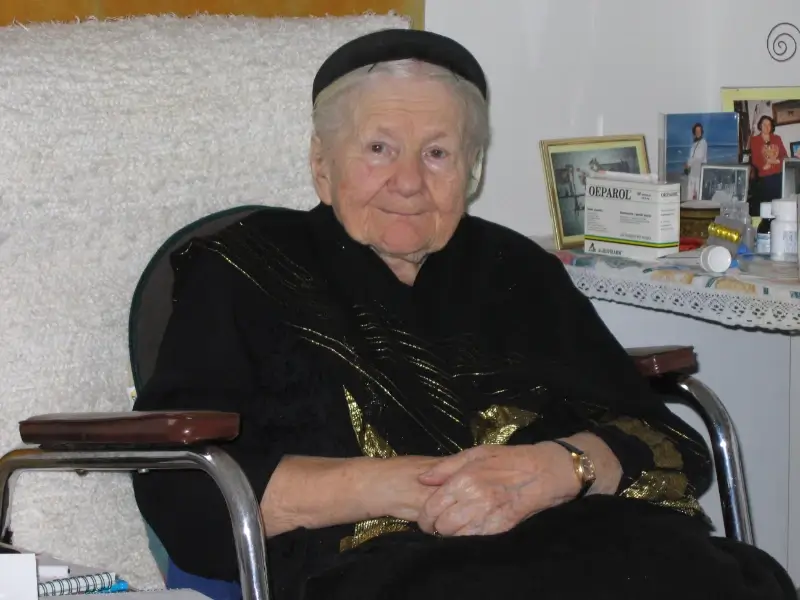
When the war ended, the world did not immediately focus on Irena Sendler. Poland faced new political realities, and stories of individual rescuers were often overshadowed by broader national narratives and the sheer scale of loss.
Irena returned to a quieter life, carrying memories that did not easily translate into public celebration. Many of the children she had helped were now growing up under new names and in new families. Some parents returned to find their children; many did not return at all.
Over time, researchers, educators, and survivors began to bring her story to wider attention. As more documentation and testimonies surfaced, the world slowly understood the magnitude of her work. She was honored as one of the “Righteous Among the Nations”, a title given by Jewish institutions to non-Jews who risked their lives to save Jews during the Holocaust.
National awards from Poland and international recognition followed. In her later years, she became a symbol of moral resistance and humanitarian courage. Yet she often insisted she had not been a hero, only someone who did what needed to be done when others were being murdered.
Why Irena Sendler’s Story Matters Today
Irena Sendler’s story matters because it proves that even when cruelty is organized and legalized, individual choices still have the power to change outcomes. She lived at a time when the state told citizens that helping Jews was a crime worthy of death. She chose to commit that “crime” thousands of times.
For students of history, her biography offers a close-up view of the Holocaust that goes beyond statistics. It shows how genocide is experienced by individuals and how resistance can take the form of one child carried in a box, one forged document, one family opening its door.
For educators and readers today, her life raises questions that remain urgent:
- How do we respond when groups are targeted and dehumanized?
- What risks are we willing to take to protect people outside our own community?
- How can we prepare our consciences so that when we face moral tests, we stand on the side of life?
By exploring Irena Sendler’s choices, we are invited to think not only about what happened then, but about what we might do now in situations of injustice and persecution.
“Irena Sendler shows that one person’s conscience can still make a difference when laws are turned into tools of persecution.”
Key Takeaways from the Life of Irena Sendler
- Irena Sendler was a Polish Catholic social worker who rescued around 2,500 Jewish children from the Warsaw Ghetto during World War II.
- She used her official access to the ghetto to plan and carry out rescue operations, working closely with the underground Zegota network.
- Children were smuggled out using creative, high-risk methods and then given new identities and sheltered by Polish families, convents, and orphanages.
- Irena kept secret records of each child’s real identity and hiding place so that surviving relatives could try to find them after the war.
- She was arrested and tortured by the Gestapo but refused to betray any children or collaborators and ultimately escaped execution with the help of the underground.
- For years after the war, her story remained relatively unknown, but she later received recognition as a major Holocaust hero and was honored as Righteous Among the Nations.
- Her life offers enduring lessons about conscience, courage, and the possibility of resistance even in systems built on fear and violence.
- Taken together, the life of Irena Sendler illustrates how courage, planning, and compassion can save lives even in the middle of systemic violence.

Add your first comment to this post