
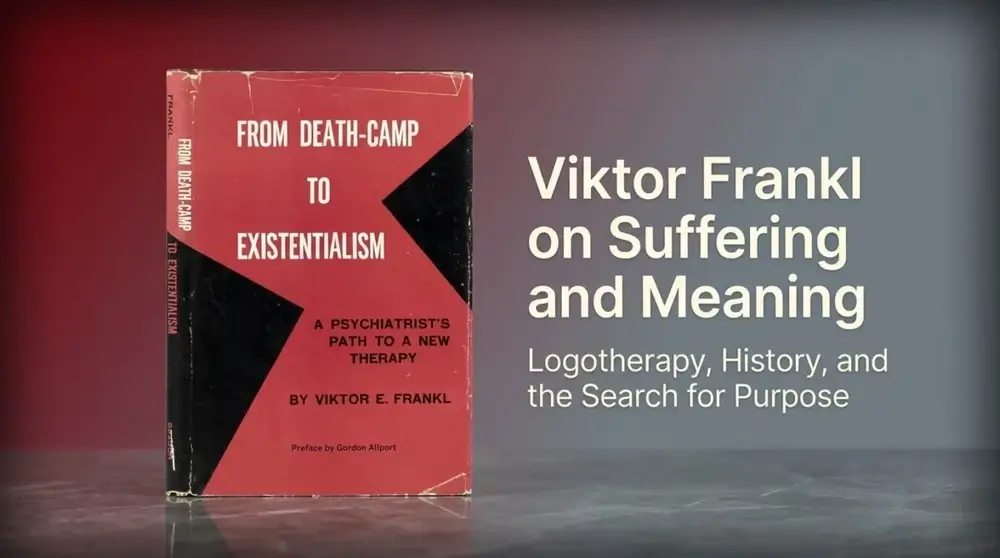

Viktor Frankl on suffering and meaning remains one of the most influential psychological frameworks for understanding resilience, responsibility, and human purpose. Developed during the turmoil of World War II, Frankl’s ideas grew from direct observation of human survival under extreme conditions. Rather than treating suffering as meaningless, he proposed that individuals could still discover purpose—even when freedom, comfort, and certainty were severely limited. Today, his work continues to guide global conversations about mental health, existential anxiety, and long-term adaptation.
Understanding these ideas requires more than simply reading Frankl’s personal story. His work developed at the intersection of history, psychology, and philosophy, particularly during the global upheaval of World War II. The conditions of wartime imprisonment forced many individuals to confront questions about survival, identity, and responsibility. Within this historical setting, Frankl began forming the psychological framework that later became known as logotherapy. Readers interested in the broader wartime environment that shaped these experiences may explore historical summaries of World War II causes and global consequences, which provide useful background context.
At its core, Viktor Frankl philosophy challenges the assumption that meaning depends solely on comfort or success. Instead, it suggests that responsibility and interpretation play a central role in shaping how individuals respond to adversity. This idea forms the foundation of what later became known as the Viktor Frankl theory of meaning, a model that continues to influence therapeutic practice, leadership development, and educational systems around the world.
This historical guide explores the origins, development, and lasting relevance of Viktor Frankl on suffering and meaning. Rather than focusing only on biography, the article examines how Frankl’s ideas emerged, how they evolved into structured psychological theory, and why they remain useful in modern discussions about resilience and long-term adaptation. By connecting historical evidence with contemporary interpretation, readers—including those in Indonesia and other regions facing social and economic uncertainty—can better understand why Frankl’s work continues to shape conversations about meaning, responsibility, and human dignity.
Table of Contents
Historical Context of Viktor Frankl on Suffering and Meaning
To understand Viktor Frankl on suffering and meaning historically, it helps to follow the key stages of his life and the wider events of the twentieth century. From the interwar period and the rise of Nazi ideology to the experience of concentration camps and post-war recovery, each phase left a distinct mark on how Frankl developed his logotherapy framework.
Broadly, the historical timeline behind Viktor Frankl’s ideas can be divided into three periods. The first is the pre-war era of study and clinical practice in Vienna. The second is the war years marked by Nazi persecution and concentration camps. The third is the post-war period, when Frankl taught, wrote, and refined the Viktor Frankl theory of meaning. These phases show how personal experience, historical crisis, and psychological insight interacted over time.
The question of suffering has followed humanity throughout historical definitions of history, philosophical traditions, and psychological inquiry. Across centuries, thinkers have tried to explain why hardship exists and how individuals endure it. Exploring Viktor Frankl on suffering and meaning allows modern readers to see not only a historical response to adversity but also a psychological framework that still shapes discussions about resilience and responsibility.
Long before the twentieth century, societies interpreted suffering through philosophy, cultural traditions, and systems of belief. Ancient civilizations recorded reflections on hardship, survival, and endurance, often preserving knowledge in intellectual centers such as Baghdad during historical golden ages. In many regions, shared customs shaped how communities responded to loss, uncertainty, and responsibility across different cultural transformations throughout history. These early reflections created foundations that later influenced philosophical and psychological attempts to explain how meaning can emerge from painful experiences.
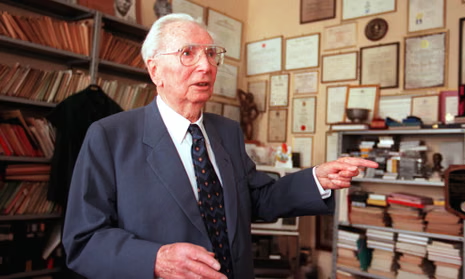
The twentieth century introduced forms of suffering on a scale rarely seen before. Beginning with World War I and intensifying through the rise of totalitarian regimes in the 1930s, industrialized warfare, political extremism, and ideological conflict amplified human loss across continents. Among the most devastating historical crises was World War II, which reshaped global politics and forced individuals to confront extreme psychological pressure. Within this environment of instability and violence, the ideas associated with Viktor Frankl on suffering and meaning began to evolve as responses to unprecedented hardship.
Viktor Frankl, an Austrian neurologist and psychiatrist, lived through one of the most destructive periods in modern history. Before the war, particularly during the 1930s, he had already begun studying psychology, motivation, and human responsibility while working with patients in Vienna. However, the rise of Nazi Germany and the annexation of Austria in 1938 dramatically altered his life trajectory. Like millions of others across Europe, Frankl became trapped within a political system that systematically targeted minorities and restricted personal freedom.
Frankl was eventually deported to several Nazi camps, including the Auschwitz concentration camp complex. Conditions inside these camps included forced labor, starvation, disease, and psychological trauma. Historical records preserved by institutions such as the National WWII Museum documentation on the Nazi concentration camp system describe these environments as deliberately designed to strip individuals of identity, dignity, and autonomy. Within this extreme historical reality, the ideas behind Viktor Frankl on suffering and meaning were shaped through observation rather than abstract theory.
While imprisoned, Frankl noticed that individuals responded very differently to nearly identical conditions. Some prisoners lost hope quickly, while others showed remarkable resilience despite severe hardship. These observations contributed to what later became known as logotherapy, a psychological approach focused on discovering meaning in life even during unavoidable suffering. This emerging framework represented a shift in the understanding of meaning in suffering psychology, emphasizing responsibility and personal interpretation rather than passive endurance.
Frankl’s experiences did not simply repeat earlier philosophical traditions. Instead, they produced a historically grounded explanation of resilience based on behavior and clinical insight. By watching how prisoners preserved dignity under extreme pressure, he concluded that meaning was not determined solely by circumstances but by the decisions individuals made in response to those circumstances. This insight became central to the long-term influence of Viktor Frankl on suffering and meaning, shaping modern interpretations of resilience across psychology, education, and leadership studies.
Logotherapy Explained: Viktor Frankl’s Theory of Meaning
One of the most influential contributions linked to Viktor Frankl on suffering and meaning is the development of logotherapy, a psychological theory centered on the search for purpose. Unlike earlier models of psychology that emphasized pleasure or power as primary motivators, Frankl argued that the deepest human drive is the pursuit of meaning. This shift marked an important development in Viktor Frankl philosophy and broadened the understanding of human motivation in modern psychology.
Before logotherapy, dominant psychological traditions were strongly influenced by Sigmund Freud and Alfred Adler. Freud proposed that human behavior is largely driven by the pursuit of pleasure. Adler emphasized the importance of power, achievement, and superiority. Frankl respected these theories but believed they did not fully explain how people endured suffering when pleasure and power were absent. His observations in extreme conditions led him to design an alternative framework that addressed survival under severe adversity.
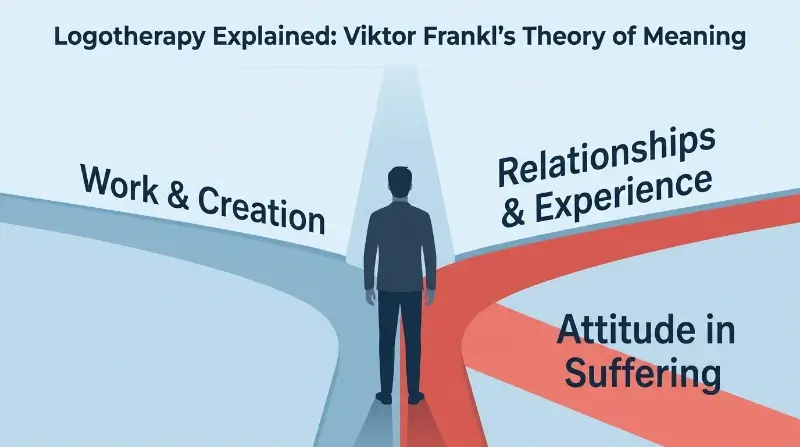
The term logotherapy comes from the Greek word logos, meaning “reason,” “purpose,” or “meaning.” In practice, logotherapy teaches that individuals can discover meaning through three main pathways. The first is meaningful work or achievement. The second is relationships and experiences with others, including love, beauty, and spiritual values. The third is the attitude chosen when facing unavoidable suffering. These three pathways form the structural foundation of Viktor Frankl on suffering and meaning and show how purpose can stabilize a person during crisis.
Frankl’s theory did not arise in isolation from reality. It grew out of direct observation during his imprisonment in Nazi camps, including the Auschwitz complex. In these environments, survival depended not only on physical strength but also on psychological endurance and a sense of responsibility. Frankl observed that prisoners who maintained a clear sense of purpose often showed greater resilience. This supported the broader idea of meaning in suffering psychology, reinforcing the belief that purpose strongly influences emotional survival.
After World War II ended, Frankl formalized his observations into a structured therapeutic model. His best-known book, Man’s Search for Meaning, combines personal narrative with psychological explanation, offering readers both historical testimony and theoretical insight. The book became internationally influential and introduced many people to the basic ideas behind Viktor Frankl on suffering and meaning. For readers who want a concise overview of the method, educational resources such as Verywell Mind’s explanation of logotherapy principles provide accessible summaries of its core concepts.
A key feature of logotherapy is its emphasis on responsibility. Frankl argued that individuals cannot always control external events, but they can choose how they interpret those events. This principle became central to Viktor Frankl on suffering and meaning and shaped what later became known as the Viktor Frankl theory of meaning. In this context, responsibility is not a burden but a kind of freedom—the freedom to choose one’s response to hardship.
Modern research continues to support parts of logotherapy. Studies in resilience, trauma recovery, and post-traumatic growth often show that people who identify meaningful goals tend to have better long-term psychological outcomes. These findings suggest that the core ideas presented in logotherapy explained remain scientifically relevant. As a result, Frankl’s framework still influences psychotherapy, leadership training, and educational programs across many disciplines.
Ultimately, the importance of logotherapy lies in how it redefines the way individuals interpret hardship. Instead of seeing suffering only as an obstacle, Frankl suggested that adversity can become a source of meaning when approached with responsibility and intention. This concept remains one of the most enduring contributions to psychological thought and continues to define the intellectual legacy associated with Viktor Frankl on suffering and meaning.
Why Viktor Frankl on Suffering and Meaning Still Matters Today
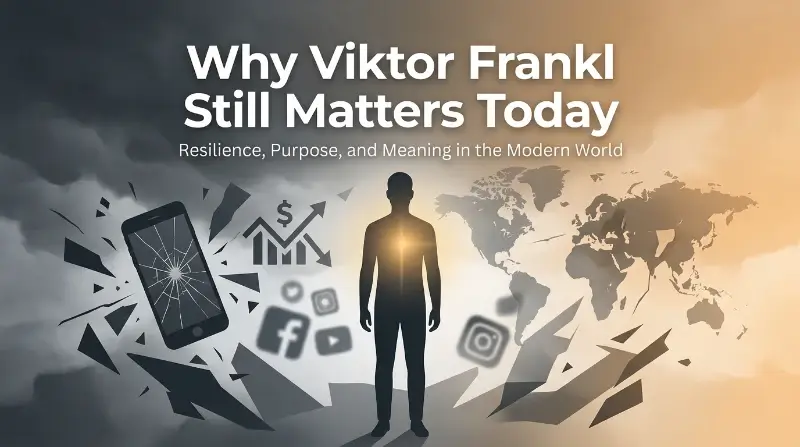
Although the ideas behind Viktor Frankl on suffering and meaning were developed in the mid-twentieth century, their relevance has expanded in modern society. Today’s hardships differ from those of World War II, yet the psychological challenge of interpreting suffering remains the same. Economic uncertainty, global instability, and personal loss continue to test how individuals respond to difficult situations. These ongoing challenges explain why Viktor Frankl philosophy still shapes modern discussions about resilience and long-term adaptation.
In the twenty-first century, researchers increasingly view resilience as a capacity that can be learned. It is shaped by belief systems, relationships, and meaningful goals, not just by personality. Studies of trauma recovery and post-traumatic growth often show that people who find purpose during hardship recover more strongly over time. These results support the central claim of Viktor Frankl on suffering and meaning, which highlights the role of responsibility and intentional action in shaping outcomes during difficult periods.
Educational institutions and professional programs also use principles related to Frankl’s theory. Universities that teach psychology, counseling, and leadership studies often include logotherapy explained in broader courses on human motivation and resilience. In the workplace, leadership training sometimes applies meaning-centered strategies to help people handle stress, uncertainty, and long-term responsibility. These applications show how the Viktor Frankl theory of meaning continues to influence both academic and professional fields.
The relevance of Viktor Frankl on suffering and meaning also appears during collective crises. History shows that communities with a shared sense of purpose often recover more effectively after disaster or conflict. Readers who want to see how societies have responded to crisis may explore examples in historical overviews of World War II causes and consequences, which show how large-scale suffering reshaped nations and communities. These patterns reinforce Frankl’s argument that purpose strengthens psychological endurance for both individuals and groups.
Technological development has created new forms of stress that Frankl did not witness directly. Social isolation linked to digital dependency, rapid information flow, and global communication pressures have changed how people experience uncertainty. Even so, the principles behind Viktor Frankl on suffering and meaning remain consistent. External circumstances may change quickly, but human interpretation of those circumstances still plays a key role in long-term resilience.
Modern discussions about mental health increasingly emphasize purpose-driven approaches. Therapies that encourage individuals to identify long-term goals often mirror ideas first associated with meaning in suffering psychology. Instead of focusing only on avoiding discomfort, people are encouraged to interpret adversity in more constructive ways. This shift toward purpose-centered thinking demonstrates the lasting influence of Viktor Frankl on suffering and meaning in current mental health practices.
For modern readers, the value of Frankl’s work lies in both its historical origin and its flexibility. Whether someone faces professional setbacks, personal loss, or social disruption, the search for purpose remains a stabilizing force. This enduring relevance explains why Viktor Frankl on suffering and meaning is still widely discussed in psychology, education, leadership training, and historical reflection around the world.
Common Misunderstandings About Viktor Frankl on Suffering and Meaning
Despite the wide recognition of Viktor Frankl on suffering and meaning, many readers still misunderstand his central ideas. Some interpretations simplify his work too much, while others remove it from its historical and psychological context. Clarifying these misunderstandings is important for readers who want to grasp the real depth of Viktor Frankl philosophy and its relevance for modern life.
One common misconception is that Frankl believed suffering itself is inherently valuable. In fact, his theory never glorified suffering. He argued that suffering becomes meaningful only when it cannot be avoided and when individuals consciously choose how to respond. This distinction is central to understanding Viktor Frankl on suffering and meaning and reflects the broader idea of meaning in suffering psychology. Frankl repeatedly stressed that when suffering can be prevented, it should be reduced or removed rather than accepted passively.
Another misunderstanding is the idea that Frankl believed optimism alone could overcome hardship. While hope is important for resilience, Frankl did not reduce survival to positive thinking. His framework focused on responsibility, purpose, and disciplined interpretation of reality. This approach separates logotherapy explained from modern motivational slogans that sometimes oversimplify complex psychological experiences.
Some readers also assume that Frankl’s ideas were purely philosophical and not based on observation. In reality, his theory grew from direct experience and systematic reflection as a psychiatrist. During his imprisonment in Nazi camps, Frankl carefully observed how different attitudes and beliefs affected prisoners’ behavior. These observations later shaped the Viktor Frankl theory of meaning, which blends psychological insight with historical evidence. Readers who want a broader picture of wartime survival can also explore historical summaries of World War I causes and global consequences, which show how extreme hardship influenced psychological endurance in earlier decades.
Another misunderstanding is the belief that Frankl rejected other schools of psychology. In fact, he respected earlier thinkers and saw his work as an addition, not a replacement. Viktor Frankl on suffering and meaning expanded the field by addressing questions that earlier models left unresolved, such as existential crisis and spiritual searching. This integrative spirit helped logotherapy gain long-term acceptance as a complementary therapeutic method.
Misinterpretations also appear when readers think Frankl’s ideas apply only to extreme situations such as concentration camps. Although his experiences in those settings shaped his insights, the principles of responsibility and meaning apply to everyday life as well. Personal loss, career challenges, and social uncertainty all involve choices about interpretation and response. This wider relevance explains why Viktor Frankl on suffering and meaning continues to resonate far beyond its original historical context.
Clarifying these misunderstandings strengthens the reader’s ability to apply Frankl’s ideas in a responsible way. When understood correctly, his work encourages thoughtful reflection rather than passive acceptance of hardship. By seeing what Frankl actually taught, readers can approach adversity with more clarity and intention, reinforcing the lasting importance of Viktor Frankl on suffering and meaning in both historical and contemporary discussions.
The Legacy of Viktor Frankl and the Future of Meaning-Centered Thinking
The intellectual legacy of Viktor Frankl on suffering and meaning extends far beyond the years in which his ideas first appeared. From his early clinical work in pre-war Vienna to his survival in Nazi camps and his post-war lectures worldwide, Frankl’s life forms a continuous narrative about how meaning can be discovered under pressure. Although his main observations were shaped during World War II, the influence of his work now reaches psychology, philosophy, education, and leadership studies.
After World War II, societies around the world had to rebuild not only buildings and economies but also psychological stability and moral frameworks. The scale of destruction forced scholars and practitioners to rethink how people interpret trauma and loss. During this period, Frankl’s focus on responsibility and purpose gained greater attention. His work became part of wider efforts to understand long-term psychological recovery after collective crisis. Readers studying global patterns of recovery may find helpful parallels in historical analyses of post-war recovery following World War II, which show how societies adapted to massive disruption.
Over time, the ideas linked to Viktor Frankl on suffering and meaning contributed to the rise of meaning-centered therapies and resilience-based counseling. Many modern psychologists now use goal-setting, narrative work, and purpose identification in their practice. These methods reflect the lasting impact of Viktor Frankl philosophy, especially in fields focused on trauma recovery and post-traumatic growth. Instead of trying to remove hardship completely, these approaches help people view challenges as chances for reflection and growth.
The continuing importance of Frankl’s work also appears in leadership and organizational development. In uncertain environments, leaders often highlight shared goals and collective responsibility. This emphasis mirrors ideas found in the Viktor Frankl theory of meaning, showing how psychological insights can shape institutional culture. Organizations that foster a clear sense of mission often adapt better during rapid change, which supports the practical value of meaning-centered thinking.
Another key area of Frankl’s legacy is education. Schools and universities increasingly see the value of teaching students how to interpret challenges constructively. Programs that promote reflection, responsibility, and long-term planning often draw on ideas similar to Viktor Frankl on suffering and meaning. By introducing these concepts early, educators help young people build psychological resilience before facing major life transitions.
Looking ahead, meaning-centered thinking is likely to become even more important. Rapid technological change, global uncertainty, and social transformation continue to reshape everyday life. In these conditions, people often face situations that demand careful interpretation and value-based decisions. The principles associated with meaning in suffering psychology offer tools for navigating uncertainty without losing direction or purpose.
Ultimately, the legacy of Frankl’s work lies in its adaptability. While the historical events that shaped his ideas belong to a specific time, the insights themselves are flexible enough to address new forms of adversity. This adaptability ensures that Viktor Frankl on suffering and meaning will continue to influence discussions about resilience, responsibility, and psychological health for future generations.
Conclusion: Understanding Viktor Frankl on Suffering and Meaning
The lasting importance of Viktor Frankl on suffering and meaning lies in its ability to link historical experience with modern psychological insight. Frankl’s ideas were shaped under some of the harshest conditions of the twentieth century, yet they speak far beyond that era. His work shows that human resilience depends not only on physical survival but also on the capacity to interpret hardship in meaningful ways.
Throughout this guide, the development of Viktor Frankl philosophy has been viewed from several angles. These include its origins in wartime imprisonment, its transformation into logotherapy explained, and its lasting impact on contemporary psychology. These stages illustrate how theory grows through observation, reflection, and practical use. They also reflect a broader pattern in which powerful ideas arise from crisis and later serve as tools for healing and growth.
One of the most valuable lessons associated with Viktor Frankl on suffering and meaning is its focus on responsibility. Frankl argued that while individuals cannot control every external event, they can still choose how they respond. This principle continues to influence modern approaches to resilience, trauma recovery, and long-term psychological stability. By emphasizing responsibility instead of helplessness, people strengthen their ability to face uncertainty without losing direction.
Another key insight is that meaning does not always arise from comfort or success. In many historical cases, including those discussed in the twentieth century, people found purpose in times of deep difficulty. These examples support the broader concept of meaning in suffering psychology, which stresses the role of interpretation in shaping emotional outcomes. Rather than denying hardship, Frankl’s framework invites honest engagement with reality and asks what life expects from us in each situation.
For modern readers, the value of studying Viktor Frankl on suffering and meaning lies in its practical flexibility. Whether used in education, leadership, healthcare, spiritual practice, or personal growth, the search for meaning remains central to long-term well-being. By understanding the historical roots and psychological implications of Frankl’s work, readers gain tools for facing uncertainty while keeping a clear sense of purpose.
In the final analysis, the legacy of Frankl’s ideas reminds us that adversity alone does not decide outcomes. What matters is how people interpret events, the responsibilities they accept, and the purposes they choose to serve. This enduring message ensures that Viktor Frankl on suffering and meaning will remain a valuable framework for understanding resilience, human dignity, and the search for purpose in an ever-changing world.

Add your first comment to this post